
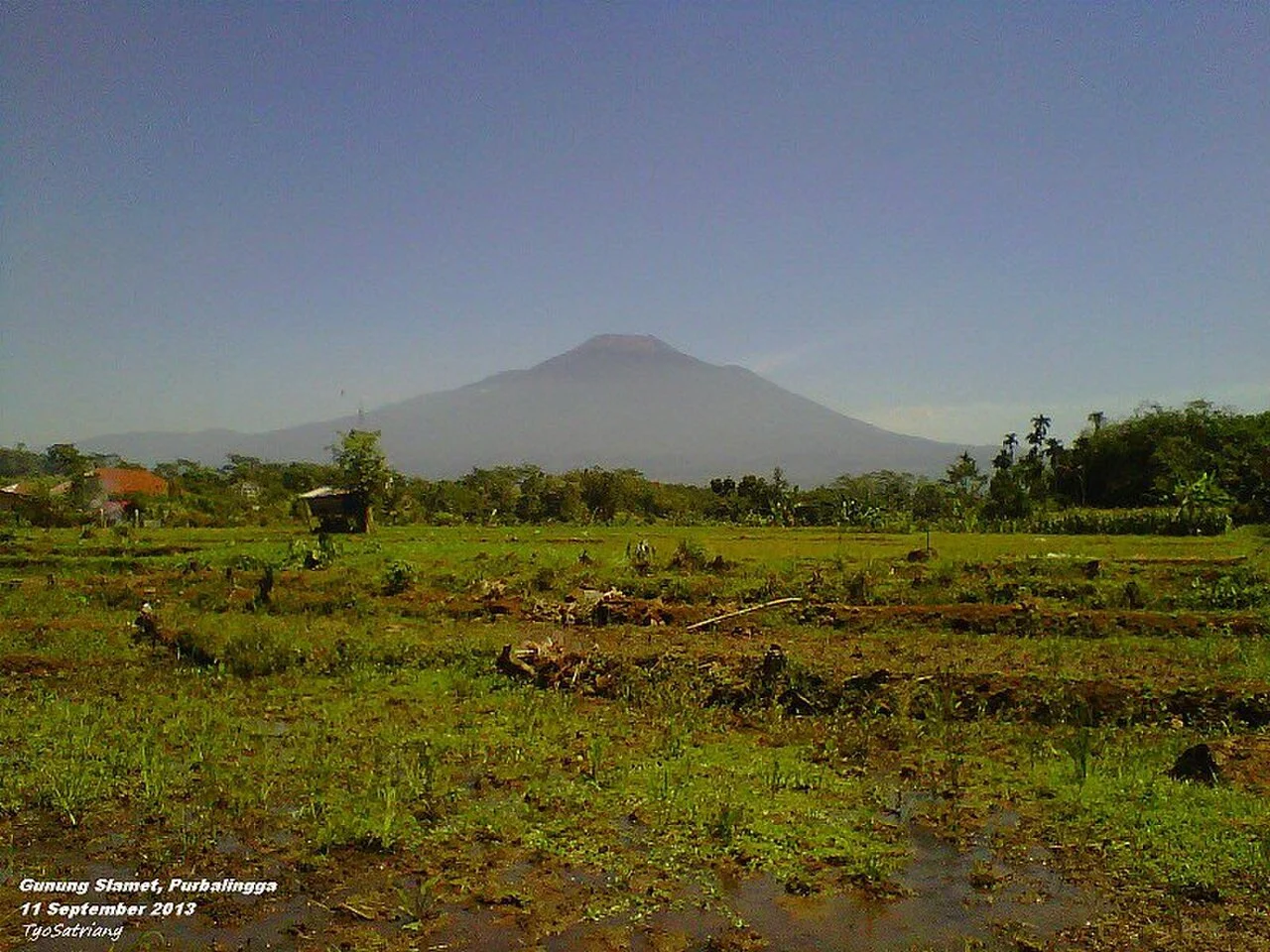
A Volcano Built in Two Stages
Slamet's bulk reflects two distinct phases of construction. The older, western portion of the edifice predates a younger eastern structure that grew against and over it, producing the compound form visible today. This two-part architecture is not merely a geological curiosity; it set the stage for the distribution of secondary vents that now dot the mountain's lower flanks, where roughly three dozen cinder cones are scattered across a broad arc running from the southeast to the northeast. These parasitic features record episodes when magma found paths to the surface well below the main summit rather than forcing its way through the central conduit.
One of the most significant of those flank features is Gunung Malang II, an upper east-flank cinder cone associated with the younger edifice. That cone was the source of a lava flow that extended approximately six kilometres eastward, a distance that underscores the volume of material the flank vents have been capable of producing. Gunung Malang II and the summit craters represent distinct chapters in Slamet's eruptive biography and should not be conflated when interpreting the volcano's behaviour.
The Summit Crater System
Slamet's summit hosts four craters, and the locus of eruptive activity within that cluster has not remained fixed — the active centre has migrated toward the southwest over time. The westernmost of the craters, measuring approximately 450 metres across and 150 metres deep, has been the documented source of recent summit events.
Recorded Eruptive History
Written documentation of Slamet's eruptions extends back to the eighteenth century, making it one of the longer volcanic records in Java. The Smithsonian Institution's Global Volcanism Program tracks this history as part of its broader catalogue of Indonesian volcanic activity. Within that long timeline, the volcano has shown recurring Strombolian behaviour — a style characterised by intermittent, relatively short-lived bursts that eject incandescent fragments and generate ash columns above the vent.
A well-documented episode of heightened unrest unfolded between March and September 2014. Indonesia's Ministry of Energy and Mineral Resources reported short Strombolian bursts during that period, with incandescent material and ash observed in the vicinity of the crater. On 12 August 2014 the ministry issued a formal briefing documenting monitoring conditions and the changes observed up to that point. The alert level was raised from Waspada — the second tier of Indonesia's four-level volcanic alert scale — to Siaga, the third tier, reflecting a meaningful escalation in assessed hazard at the time. This episode is a matter of historical record only.
Geological Significance in the Java Arc
Slamet sits within the Sunda Arc, the volcanic chain produced by the northward subduction of the Indo-Australian Plate beneath Eurasia, a tectonic setting responsible for the dense concentration of active volcanoes across Java, Sumatra, and Bali. What distinguishes Slamet within that chain is the clarity with which its structure illustrates volcanic field evolution: the coexistence of an older and a younger edifice, a dispersed cinder-cone field, and a migrating summit vent together provide a compact record of how stratovolcanoes reorganise their plumbing over geological time. For researchers and students of volcanology, the mountain serves as a reference case for compound edifice growth in an island-arc setting.