
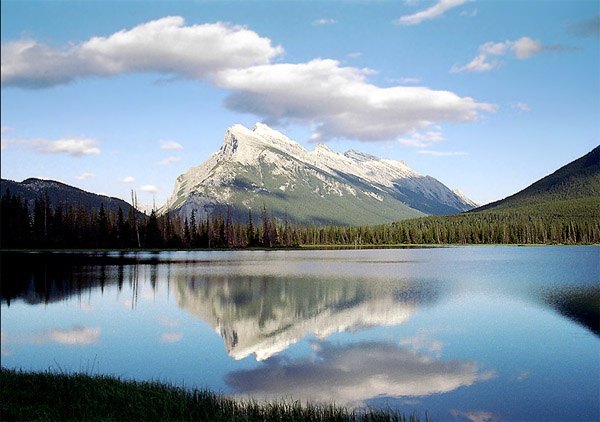
Names and History
The mountain's Cree name was Waskahigan Watchi, meaning house mountain. In 1858, explorer John Palliser renamed it after Reverend Robert Rundle, a Methodist missionary invited by the Hudson's Bay Company to work in western Canada during the 1840s. Rundle is associated with the introduction of syllabics to the region — a writing system developed for the Cree — as part of his missionary activity. His direct contact with the Stoney-Nakoda people of the area around the mountain took place only on two occasions: in 1844 and again in 1847.
In 2000, writer Dave Birrell described Mount Rundle as one of the most recognized mountains in Canada. Its prominence in the cultural landscape of the Rockies extends well beyond the climbing community, rooted in the visual drama of a ridge that is visible from two separate towns and shifts in appearance through every change of light.
Mountain as Subject: Walter Phillips and the Artistic Record
Few mountains in Canada have generated as sustained an artistic response as Mount Rundle. Painter, printmaker, and art teacher Walter Phillips RCA (1884–1963) called it his "bread and butter mountain," writing that he never tired of painting it because it was never the same — deep in shadow in the morning, borrowing warmth from the setting sun at day's end, its colour running through a wide range with every shift in conditions. This body of work by Phillips, produced over decades, contributed significantly to the mountain's identity as a Canadian visual landmark.
The quality Phillips identified — the mountain's responsiveness to changing light and atmosphere — is itself a product of its massive, unbroken southern face and the angle of its ridge, which presents a dramatically different aspect depending on time of day, season, and vantage point. The views from both Banff and Canmore are distinct, and the ridge changes character entirely from the summit.
The Ridge Traverse
The integral ridge traverse of Mount Rundle — running from Banff to Canmore while remaining on the ridge throughout — represents one of the more demanding undertakings the mountain offers. The first recorded solo completion of the full traverse was achieved in 1976 by Jean-Pierre Cadot, who required one bivouac along the way. The route involved sustained scrambling, easy fifth-class rock climbing, and one particularly involved section requiring lay-backing the ridge at significant exposure. A long rappel was necessary to descend a very steep step in the ridge.
To the west of the Spray Lakes road lies the East End of Rundle, locally known as EEOR, a distinct lower summit that has developed its own following among scramblers. The range of technical challenge across the mountain's seven peaks — from accessible scrambling terrain to the commitment required by the full ridge — reflects the depth of the mountain as a climbing destination within Banff National Park.