
Structure and Glacial Geometry
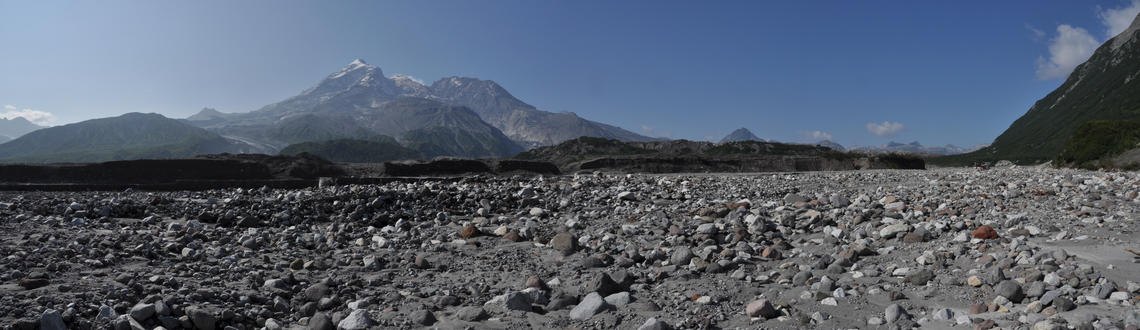
Redoubt stands at 3,108 metres and is built from alternating lava flows and pyroclastic deposits typical of a stratovolcano. Its crater holds a substantial ice mass and is breached on the northern side, allowing Drift Glacier to descend through the opening toward the Drift River valley below. That arrangement places a large volume of frozen material directly adjacent to any eruptive vent, creating conditions for lahar generation when hot volcanic material contacts the glacier and meltwater and debris are channeled down the Drift River.
The 1989-90 Eruption and the KLM Flight
An explosive phase began on 14 December 1989. On 15 December, a KLM Boeing 747 flying from Amsterdam to Tokyo, on a scheduled approach to Anchorage, encountered Redoubt ash, lost power in all four engines, regained power, and landed safely at Anchorage. The Alaska Volcano Observatory documents the encounter as part of the 1989-90 eruption record.
The 2009 Lahars
The 2009 eruption produced two large lahars that descended into the lower Drift River valley and affected an oil storage and transfer facility there. The 23 March lahar left deposits unusually rich in snow and ice. The 4 April flow left deposits dominated by sand and fine gravel, a markedly different material signature from the same valley reach.
For the 4 April event, the USGS report infers the flow began when hot material from a collapsing lava dome melted and entrained snow and ice to generate the lahar. That interpretation is an inference drawn from field observations and deposit character. The two flows illustrate how a single eruption sequence can produce lahars through different pathways and leave distinct stratigraphic records in the same valley.