
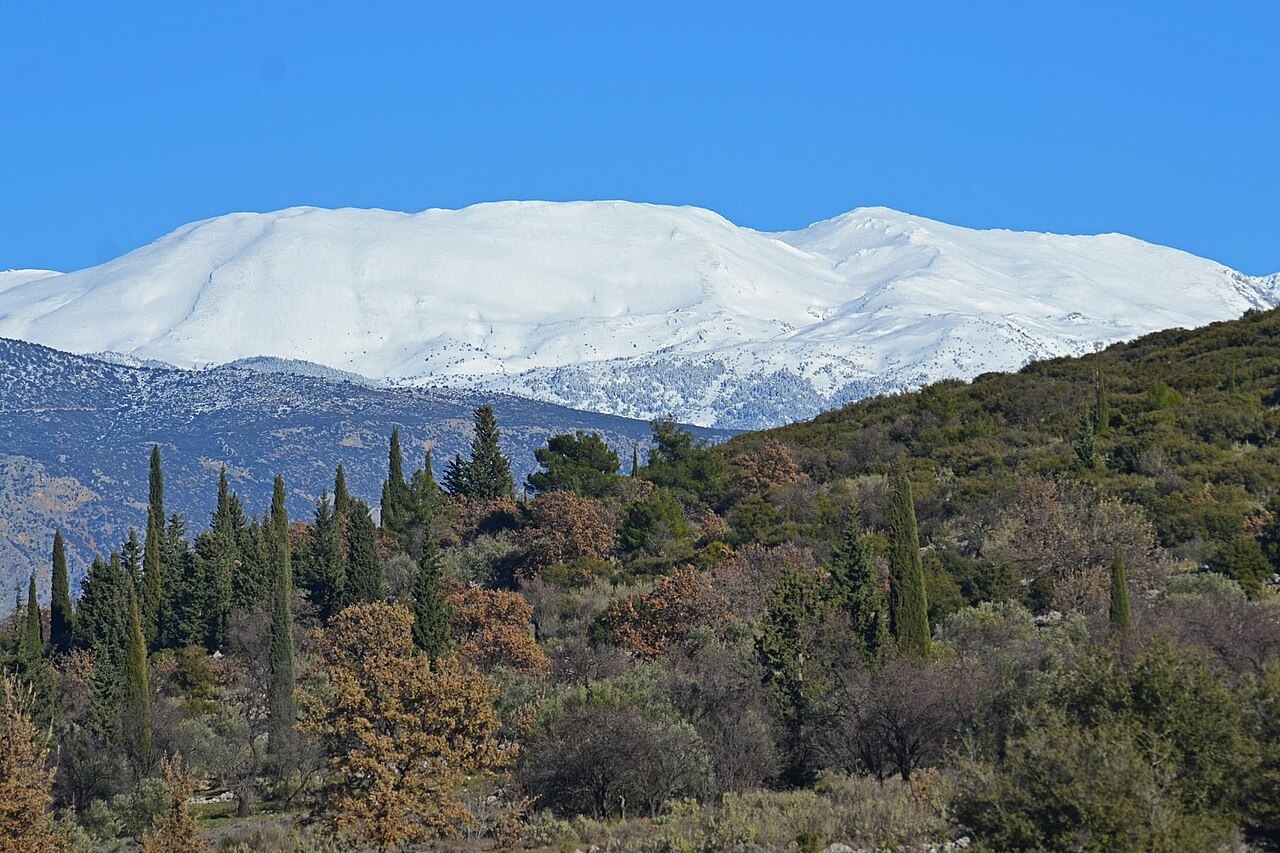
Karst Terrain
Hard limestone dominates much of Parnassos National Park, and park documents identify characteristic depressions — dolines and sinkholes — across the terrain. Rainwater drains into fractures and dissolves the carbonate rock below, with depressions deepening progressively as the rock dissolves, shaping both the surface morphology and the underground drainage of the massif. NECCA's conservation surveys record six locally endemic plant taxa within the park, among them Erysimum parnassi, a crucifer restricted to the mountain.
The Phaidriades Cliffs and Delphi
On the southwestern slopes, below the sheer rock faces known as the Phaidriades cliffs, lies the archaeological site of Delphi. UNESCO inscribed Delphi on the World Heritage List in 1987, defining the listed property as the archaeological sanctuary of Apollo at Delphi — a Panhellenic sanctuary that received dedications from communities across the Greek world.
The Corycian Cave
Beyond Delphi, the Parnassus park also contains the Corycian Cave, a limestone karst feature where, according to the Greek National Tourism Organisation, Pan and the Nymphs were worshipped in antiquity.