
Terrain and Vegetation
The mountain rises from miombo woodland and lower forest near the lakeshore, transitioning into montane forest at roughly 1,800 m. Above the highest forest the terrain opens into grass and low scrub that continues toward the summit ridge. Older field publications use the spelling Kungwe. Tanzania National Parks uses Nkungwe on the park map. The Mahale Mountains became a national park in 1985.
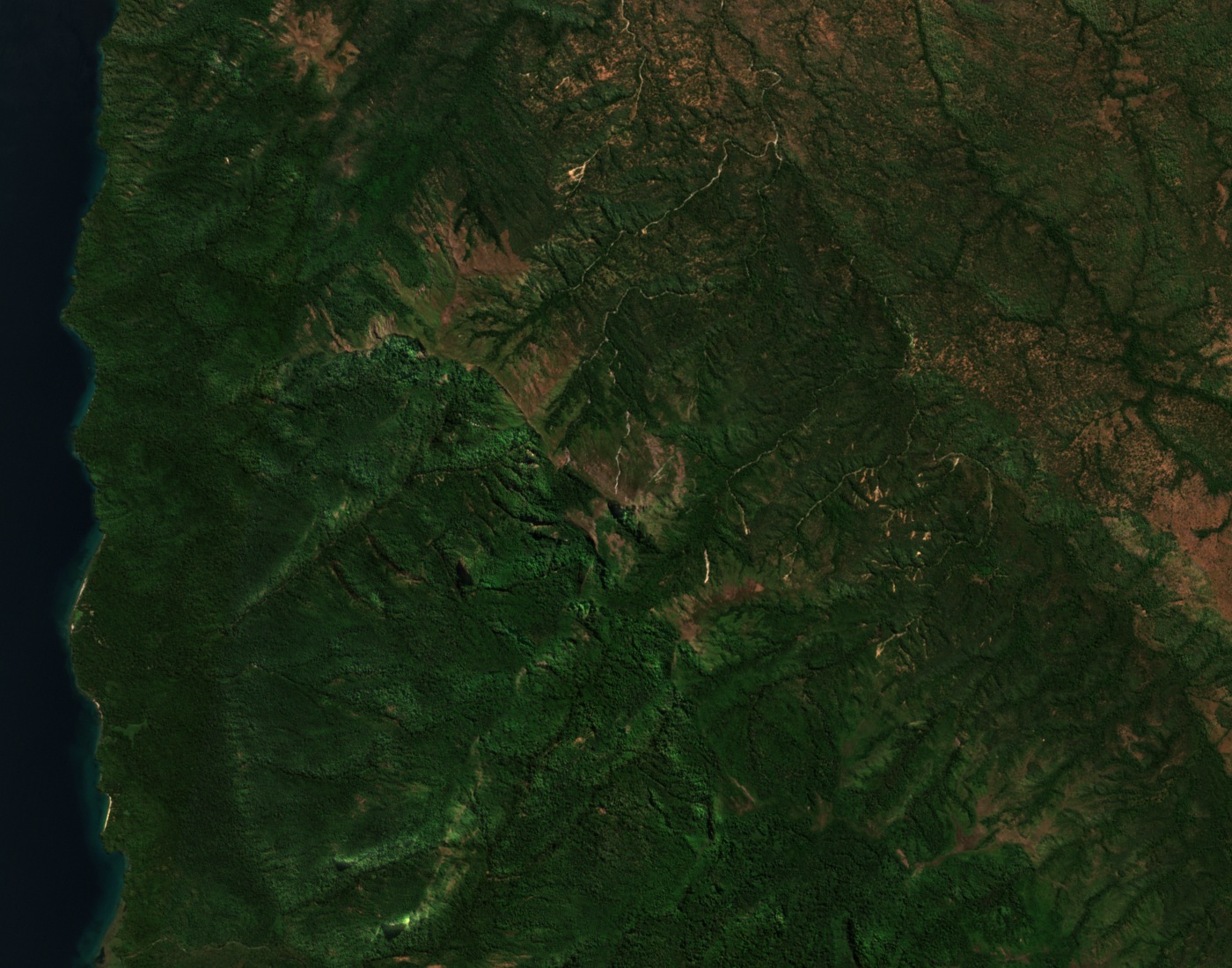
A June 2026 Sentinel-2 image shows dark forested ridges centered on Nkungwe with Lake Tanganyika's open water to the west. Deep valleys cut between the ridges.
Survey and Natural History Fieldwork
R. E. Moreau published observations on birds of the Kungwe–Mahare highlands in 1943, drawing on specimens gathered by a local collector whose work Ulfstrand and Lamprey recorded in 1960. Staffan Ulfstrand and Hugh Lamprey followed with a bird survey in 1960, treating the isolated mountain block as a contact zone for regional distributions. Toshisada Nishida began chimpanzee research at Mahale in 1965, and the 2015 synthesis of that program credits the local knowledge of Tongwe field assistants. A georeferenced specimen collected northwest of the summit appears in Carlen and colleagues' 2017 molecular phylogeny of giant sengis.
In April 2022, park rangers and guides participated in a survey training exercise led by Thomas Butynski and Yvonne de Jong. The team identified a campsite at Parinari, at 2,183 m in montane forest on the Nkungwe ridge.
Galago Records from the 2022 Survey
The 2022 team recorded Thomas's dwarf galago (Galagoides thomasi) at two sites in the park, constituting the first park records according to the published report. At the lower Mfiga site the team captured distinctive crescendo calls on recording equipment. At Parinari, the team recorded what it described as a possible alarm call on 18 April. On 21 April, observers reported seeing and hearing the species there. Strong winds made listening difficult on two nights at the upper camp.