
Caldera Architecture and Summit Craters
At Marapi's summit lies the Bancah caldera, approximately 1.4 kilometres across, within which several overlapping craters have accumulated over successive eruptive cycles. The Smithsonian Global Volcanism Program's records document a westward migration of activity across this crater field over time. No historical lava flows extending beyond the summit crater zone have been recorded per the Smithsonian.
The concentrated nature of Marapi's eruptive output — focused within the caldera rather than expressed as broad flank flows — has shaped a summit landscape of nested vents and accumulated tephra rather than the extensive lava fields characteristic of some neighbouring volcanoes. This architecture makes the Bancah caldera itself the primary theatre of the mountain's geological story.
A Long Record of Explosive Activity
Marapi has sustained one of the more continuous eruptive histories among Sumatran volcanoes, with the Smithsonian Global Volcanism Program cataloguing numerous small to moderate explosions from the late eighteenth century onward. The pattern is one of recurrence rather than singular catastrophe: the mountain returns repeatedly to activity after intervals of relative quiet, expressing itself most commonly through ash emissions and short-lived explosive bursts rather than sustained effusive episodes.
The year 2023 illustrated this pattern across several months. Ash episodes were documented in both January and February before the most significant event of that cycle: on 3 December 2023, at 14:54 local time, an explosive eruption generated an ash column that the Indonesian Geological Agency estimated at approximately 3 kilometres above the summit. Agency observers monitoring the event from Bukittinggi combined visual observation with instrumental data to characterise the eruption's scale and progression.
Regional Setting and Geographic Identity
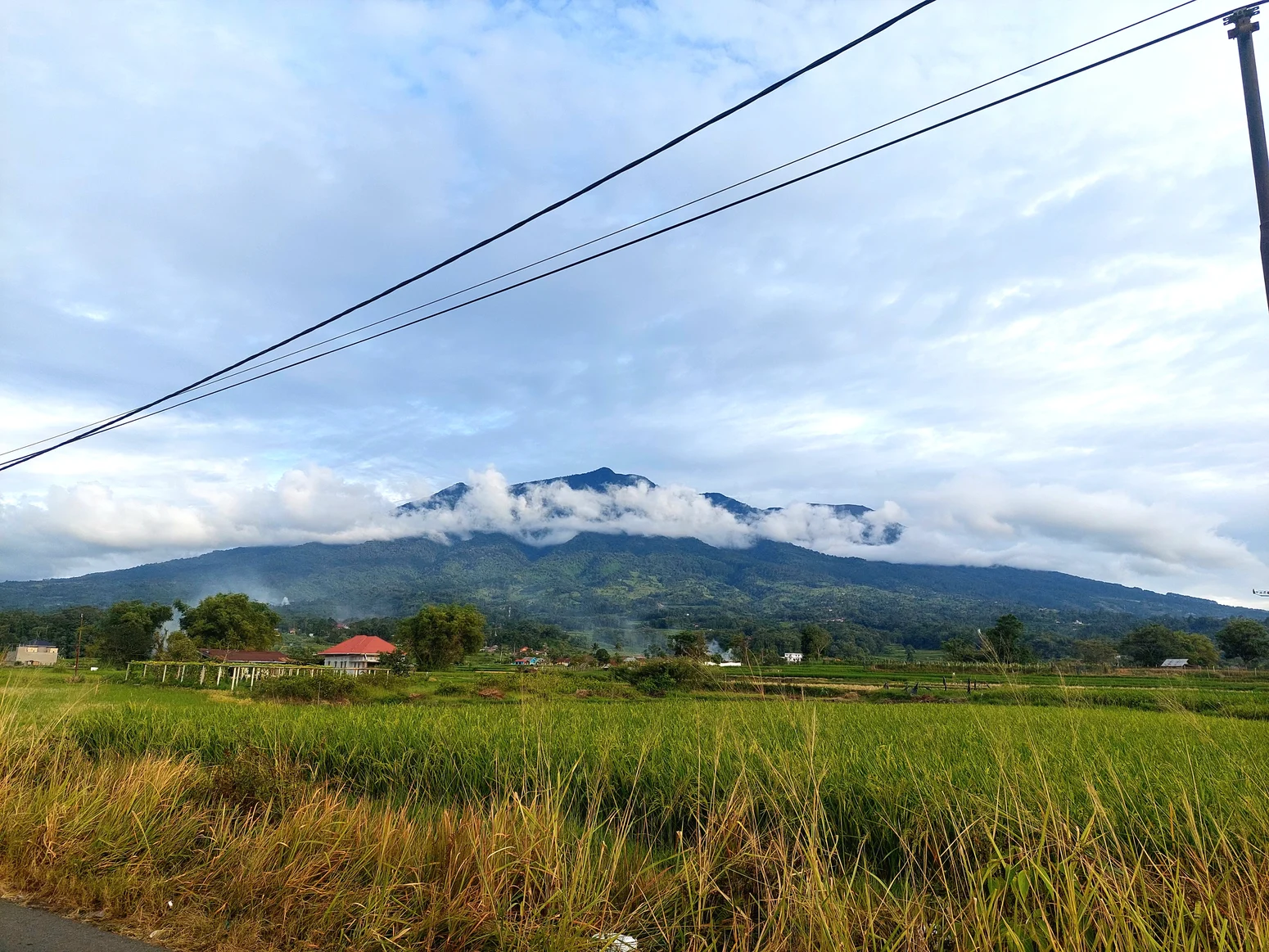
Marapi rises above the Bukittinggi plain, a highland zone in West Sumatra where the mountain serves as an unmistakable landmark for the surrounding Minangkabau cultural heartland. Its position in both Agam and Tanah Datar districts places it within a densely populated and historically significant region, where the volcano's behaviour has been observed and recorded by nearby communities across generations.
Confusion with other Indonesian volcanoes sharing similar names is a persistent issue in both popular and technical literature. Marapi of West Sumatra is an entirely separate edifice from the famous Merapi of Central Java and from the Merapi associated with the Ijen volcanic complex in East Java. Each has its own eruptive character, monitoring record, and geographic context; the Sumatran Marapi's identity is properly anchored to its Bancah caldera, its Bukittinggi plain setting, and the monitoring infrastructure of the Indonesian Geological Agency's West Sumatra network.