
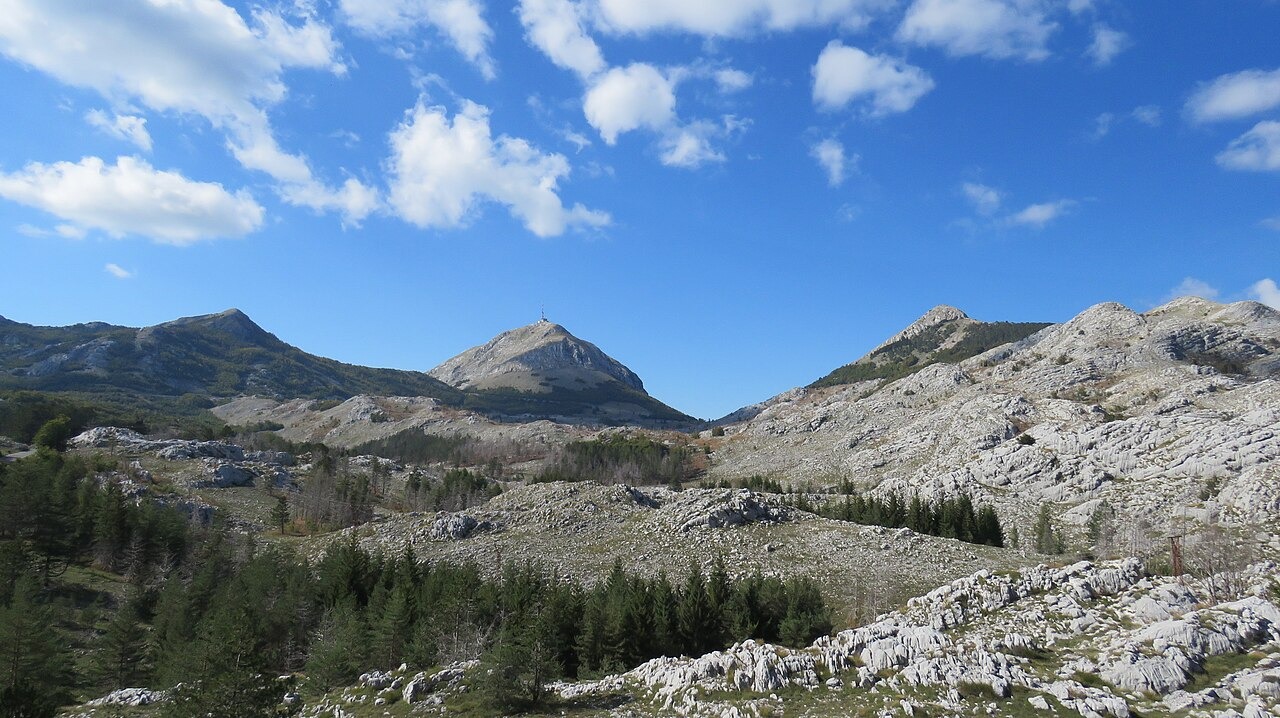
Two Summits and Their Geology
The Montenegrin government reports that the massif is composed of Triassic and Jurassic limestone and dolomite, with steep slopes descending toward the Bay of Kotor. Štirovnik, at 1,749 metres, is the highest point of the massif. Jezerski vrh, to the east, reaches 1,657 metres. The two peaks are geologically continuous but topographically distinct, and each carries separate cultural and institutional significance.
Name and Identity
The UK Permanent Committee on Geographical Names links the mountain's appearance to the country name Montenegro, itself a Venetian rendering of Crna Gora, meaning Black Mountain in South Slavic. That connection, attributed to the toponymic authority, reflects how the massif's dark forested slopes read from the coast and contributed to a national identity rooted in this specific landscape.
The Njegoš Mausoleum on Jezerski vrh
The lower eastern summit, Jezerski vrh, is the site of the mausoleum of Petar II Petrović-Njegoš, the nineteenth-century ruler, bishop, and poet central to Montenegrin cultural history. According to the National Museum of Montenegro, the decision to commission a replacement for a previous chapel on the summit was taken in 1951. The mausoleum, designed by the sculptor Ivan Meštrović, was completed in 1974 and is administered by the National Museum.