
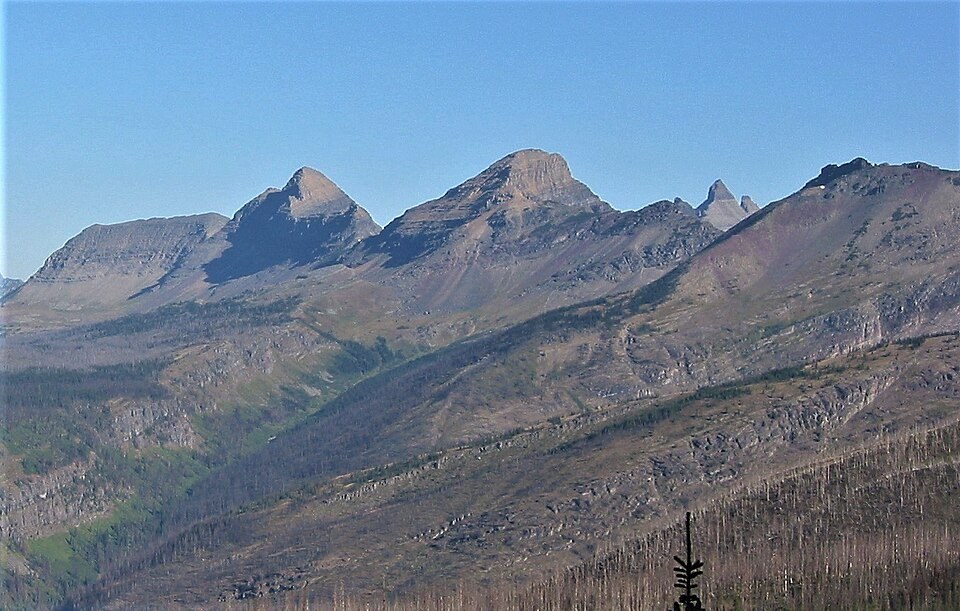
A Name Probably Honoring Joe Kipp
The National Park Service administrative history records that the peak's name probably honors Joe Kipp, an early hunter and trapper whose mother, Ipasha, was Mandan. The Board on Geographic Names formally adopted the current name in 1929. An early illustrated map of the Glacier and Waterton region lists the peak in the same area, placing the name within a broader tradition of early cartographic documentation for this part of the divide. Mount Kipp is distinct from the similarly named Kipp Creek and from nearby Cathedral Peak, which appears to its left in views from the north.
The Continental Divide and Ice Documentation
The prominence of the divide at this location made it a natural reference frame for historic survey mapping of ice and high ridges across the park. NPS repeat-photography records include a Chaney Glacier image from 2005, taken from a known vantage point as part of a long-running effort to document glacier views from fixed locations over time. Recording observations from consistent positions allows researchers to compare conditions across different years in the photographic archive.
Surrounding Terrain
Ahern Pass defines the broader high-country setting around Mount Kipp, connecting the peak to one of the park's notable divide crossings. The relationship between the summit, the adjacent glacier basin, and the divide ridge is documented in both historic survey maps and later aerial photography, establishing Mount Kipp as a fixed geographic reference within the northeastern section of Glacier National Park.