
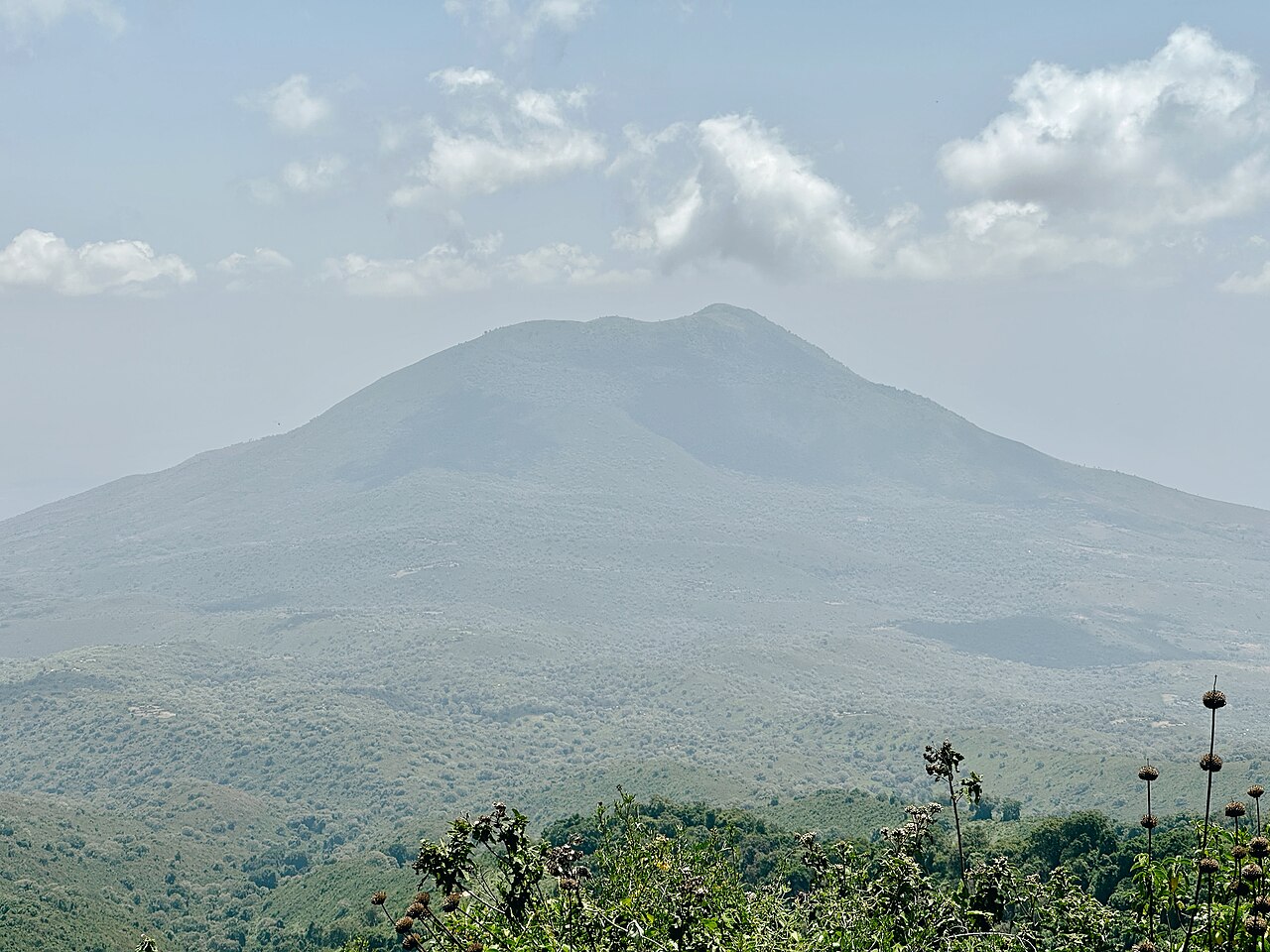
Rift Setting and Eruptive History
Mount Kerimasi sits astride a scarp of the eastern Gregory Rift in northern Tanzania. The Smithsonian Global Volcanism Program associates the volcano's eruptive activity with rift faulting estimated at roughly 600,000 to 400,000 years ago. Káldos and colleagues place Kerimasi approximately 12 km from Ol Doinyo Lengai, the neighbouring active carbonatite volcano referenced in regional comparative studies.
Carbonatite Geology
Carbonatite is defined by a dominant composition of carbonate minerals, the mineral family found in limestone and marble, rather than the silicate minerals that constitute the great majority of volcanic rocks worldwide. Kerimasi's stratigraphic record includes nephelinite, phonolite, and carbonatite pyroclasts, a compositional range broader than carbonate alone. This variety reflects multiple eruptive episodes that built the stratovolcano's present form.
Melt Inclusion Research
Káldos and colleagues analysed 180 melt inclusions hosted in magnetite and clinopyroxene within jacupirangite, a coarse-grained pyroxene-rich igneous rock from Kerimasi. Melt inclusions are microscopic pockets of ancient melt sealed inside host crystals at the moment of crystallisation, preserving compositions before subsequent reaction. From this dataset, the researchers hypothesized a separation of carbonate-rich and silicate-rich melts in the studied rocks.