
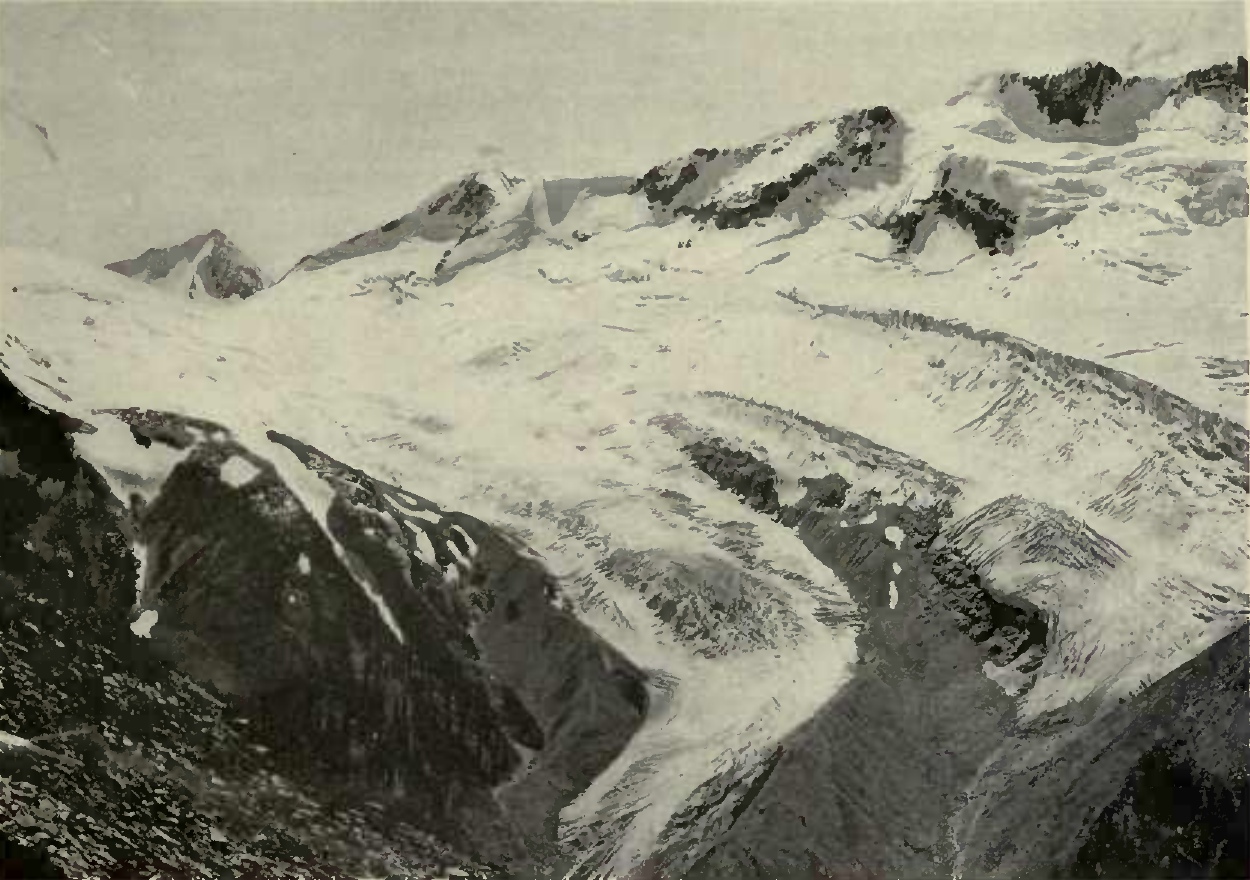
Name
Castor, Pollux, and Leda form a linked classical naming scheme for the three summits of the massif. A. O. Wheeler's 1905 work recorded the three points as a group. The name passed through an earlier form, Jove, before Mount Jupiter became the official Canadian designation in 1960.
Early ascents
The first recorded ascent of Castor was made in 1895 by an Appalachian Mountain Club party that included Philip Abbot, Charles Fay, and Charles Thompson. Pollux was first recorded as climbed in 1897, with Peter Sarbach, a Swiss guide, among the party.
Asulkan Glacier
A 1902 photograph by the Detroit Photographic Company, published in William Sherzer's 1907 report, shows the east face of the ridge above Asulkan Glacier with summits labeled left to right as Leda, Pollux, and Castor. Sherzer described formerly joined ice streams in the Asulkan setting beginning to separate, with exposed rock ridges becoming visible between them — observations made in the early twentieth century.