
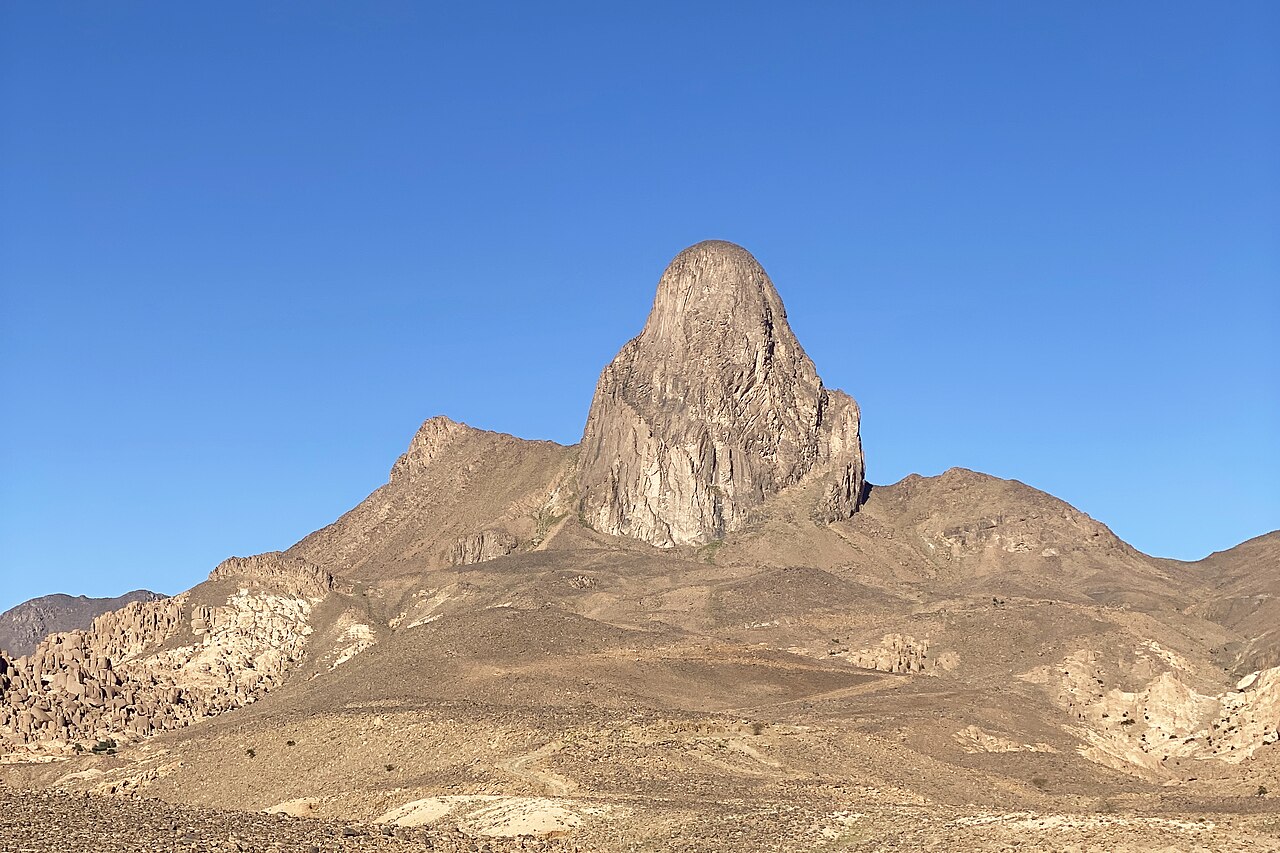
An Alkaline Rock Frozen at the Surface
Phonolite is an alkaline volcanic rock that consolidates from viscous, silica-poor magma. At Ilamane the material rose as a concentrated, largely unspread extrusion rather than spreading across the terrain as the region's basaltic flows did. Geological accounts published in the Revue géographique de l'Est note this contrast with flatter features elsewhere in the Atakor district.
A Pinnacle Shaped by Differential Resistance
As surrounding material of lower resistance weathered over geological time, the dense phonolite mass persisted and the pinnacle's current profile emerged. Research by Azzouni-Sekkal and colleagues on Atakor volcanism places Ilamane within a district shaped by multiple eruptive episodes, each leaving landforms of distinct rock type, hardness, and silhouette across the massif.
Position Within the Hoggar Highland
CNES identifies the Hoggar as one of the great mountain massifs of the Sahara, and the Atakor forms its elevated interior. Ilamane stands within that interior alongside contrasting neighbours — the wide basaltic plains and the tabular Akar Akar — making the Atakor a compact record of varied volcanic expression within a single high-altitude Saharan district.