
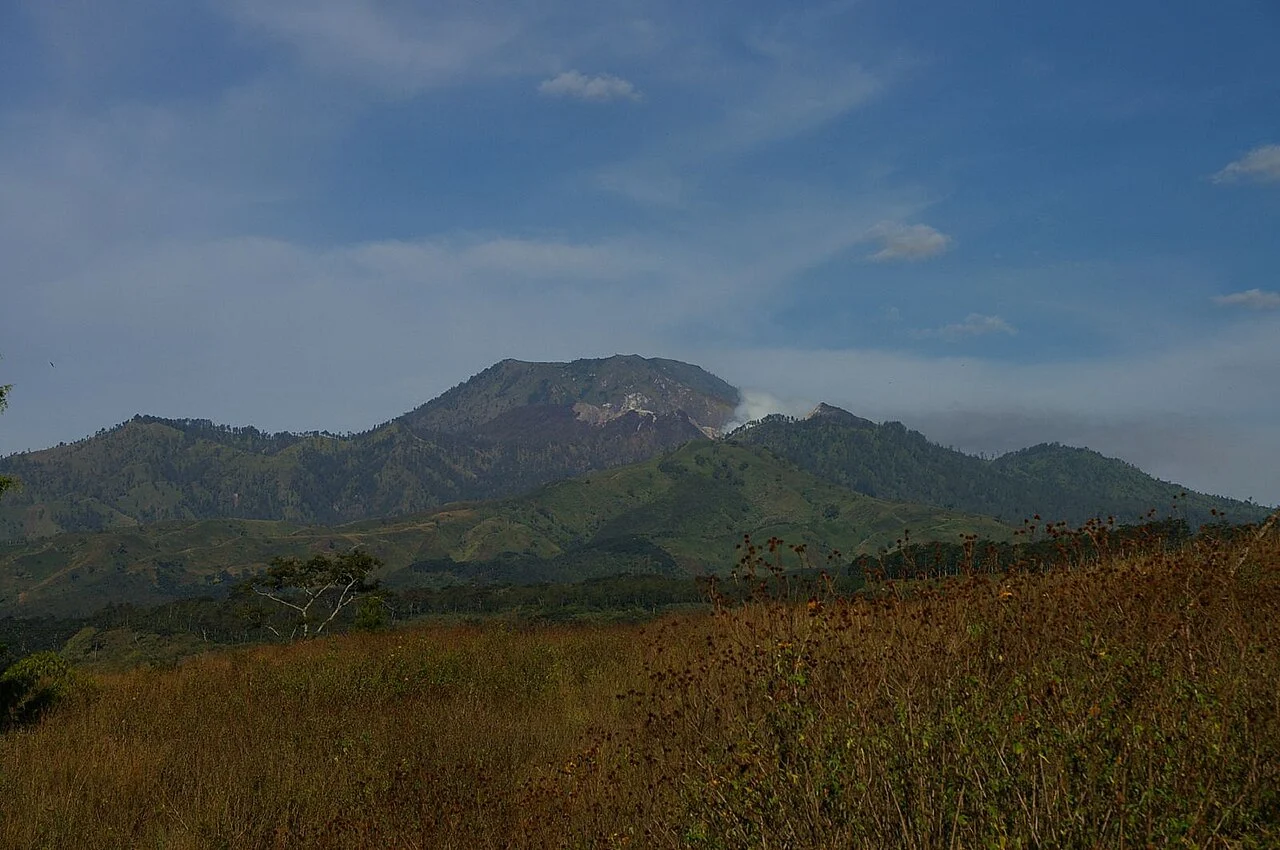
Summit, Crater, and the Caldera They Share
The Smithsonian Global Volcanism Program identifies the highest point of the Ijen complex as Gunung Merapi — a summit on the complex's eastern edge listed at 2,769 m in the current profile, though an earlier report within the same profile quotes 2,799 m from a historical map. This peak is distinct from the separate volcano of the same name near Yogyakarta in Central Java. Kawah Ijen, the active crater whose activity defines the complex, sits on the western flank of Gunung Merapi.
The caldera itself is older than the younger cones that now occupy it, and several of those cones stand on or near the caldera rim. This nested architecture — a large ancient collapse structure containing multiple younger eruptive centres — gives the Ijen complex its geological depth and accounts for the variety of landforms compressed into a relatively compact highland area.
Kawah Ijen and Its Crater Lake
Kawah Ijen cradles a crater lake nearly one kilometre wide whose colour is a distinctive turquoise. The lake is among the most acidic natural bodies of water documented on earth. Hot volcanic gases rise through vents in the crater, and sulfur-bearing gases in those emissions can ignite when exposed to atmospheric oxygen, producing what observers describe as electric-blue flames. East Java provincial sources and UNESCO describe this as burning sulfur gas, not some form of blue lava as some popular accounts suggest.
Sulfur Extraction and Living Heritage
The sulfur deposited by those same volcanic gases around the crater vents has supported a tradition of manual extraction carried out by workers who descend into the crater, break away solidified sulfur, and carry loads back up on foot. East Java provincial and UNESCO documentation specifically names this practice as part of the geopark's living heritage, treating it as an expression of the relationship between the local population and an active volcanic landscape rather than as spectacle. The work is demanding and conducted in an environment of hot, corrosive gas.
UNESCO designated the Ijen Global Geopark in 2023, bringing the complex under an international framework that formally recognises both its geological character and this human dimension. The geopark encompasses geosites distributed across Banyuwangi and Bondowoso and also overlaps spatially with the Belambangan Biosphere Reserve, reflecting the range of ecological and cultural values concentrated in the broader highland region.
Geology and Geopark Context
The Ijen complex is part of a volcanic arc running along Java's southern margin, itself a product of the subduction of the Indo-Australian Plate beneath Sundaland. The layering of eruptive episodes visible in the caldera walls and in the younger cones provides a readable record of successive volcanic phases. UNESCO's 2023 geopark designation cites this geological documentation alongside the sulfur-mining tradition as the two principal facets that the geopark was established to recognise and protect.