
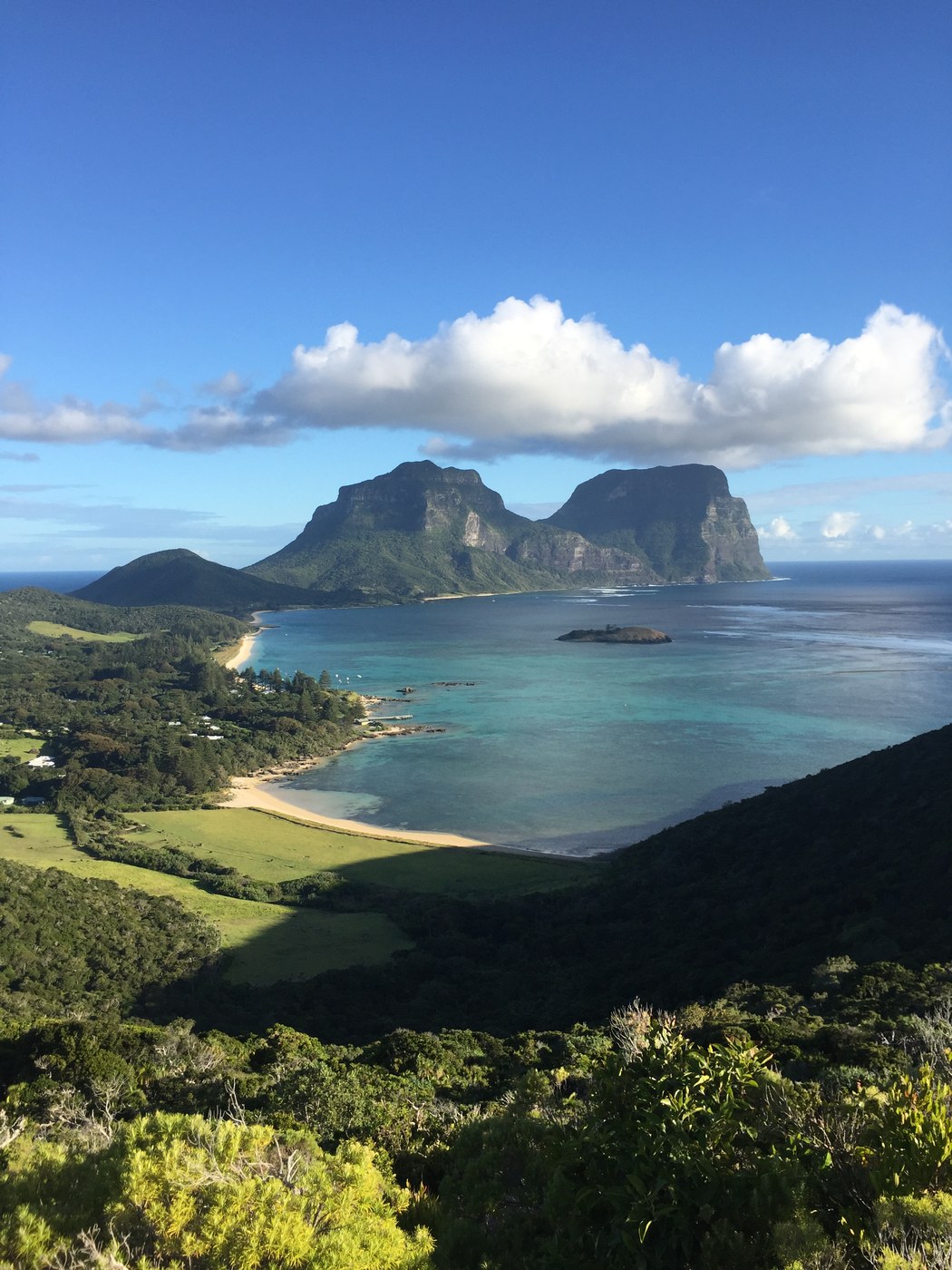
Volcanic Origins
The basalt that forms Mount Gower and its near neighbour Mount Lidgbird solidified during a volcanic phase approximately 6.3 million years ago. This oceanic basalt foundation gives the island its dramatic vertical profile, with Gower's summit cliffs rising steeply from a relatively compact landmass surrounded by deep water. The age and isolation of this volcanic platform are inseparable from the ecological rarity that developed upon it.
A Summit Fed by Cloud
What distinguishes Gower's high ground is not rainfall alone but cloud interception. As moist air moves across the ocean and strikes the summit, cloud moisture condenses directly onto vegetation, supplying water that would otherwise be absent. This process sustains the gnarled mossy cloud forest — a dense, low-canopied community of twisted trees draped in mosses and epiphytes — that covers the mountain's upper reaches.
The same community caps Mount Lidgbird, but on Gower it reaches its greatest development. The NSW Scientific Committee has listed the gnarled mossy cloud forest on Lord Howe Island as a critically endangered ecological community, identifying the loss of regular cloud cover driven by climate change as a primary threat. Because the community depends entirely on sustained cloud interception, any long-term shift in regional cloud patterns would directly diminish the moisture supply that keeps it alive.
Ecology in an Oceanic Context
Tropical in appearance yet temperate in moisture regime, Gower's summit presents a striking ecological paradox on what is otherwise a small, low-latitude island. The moss forest creates conditions — deep humus layers, persistent dampness, reduced light — that support species found nowhere else on Earth. The island's World Heritage status reflects the degree to which this isolation has allowed unique evolutionary trajectories to unfold, and the summit cloud forest represents one of the most concentrated expressions of that distinctiveness.