
Mount Eliza and Eliza Bluff
The state gazetteer recorded the name Mount Eliza on 2 September 1970. The topographic survey marks the named mountain at 1,289 m and a separate point near Eliza Bluff at 1,311 m. A narrow saddle connects the bluff to the main plateau. Just north of the bluff, a government team surveyed a seasonal snow patch on a steep northeast-facing slope in 2015. Its upper edge lay between 1,273 and 1,276 m.
The snow patch lies on Precambrian quartzite, with a transition to Jurassic dolerite at the lower edge of the study site. The Pedder geological survey maps the younger dolerite across the upland between Mount Anne and Mount Eliza. Cushion plants and pandani grow on the exposed plateau.
Glacial Valleys and Cosmogenic Dating
Lake Judd occupies the southern of two large glacial valleys east of the Mount Anne–Eliza upland. The geological survey identifies a sheer dolerite escarpment rising 600 m above the lake. The other valley contains Lake Timk. Long ridges of sediment, called lateral moraines, trace the sides of both valleys and preserve former ice margins.
On nearby Schnells Ridge, Kevin Kiernan, L. Keith Fifield and John Chappell measured beryllium-10 in quartzite boulders. This isotope accumulates in exposed rock as cosmic rays interact with minerals near the surface. Four boulders on the innermost moraine yielded an exposure age of 19,400 ± 600 years in their 2004 study. Boulders on the outer moraine returned ages between 39,000 and 141,000 years, evidence of a more complicated glacial history at Schnells Ridge.
High Camp Memorial Hut
Hobart Walking Club members built the High Camp Memorial Hut from local stone below the plateau. They carried cement and roof iron up the hillside to the site. The club opened the shelter in March 1974 for people walking on Mount Eliza and Mount Anne. Builder Olaf Moon identifies the three members it commemorates as Agnete Damgaard, Olegas Truchanas and John Plaister, who died in 1971 and 1972.
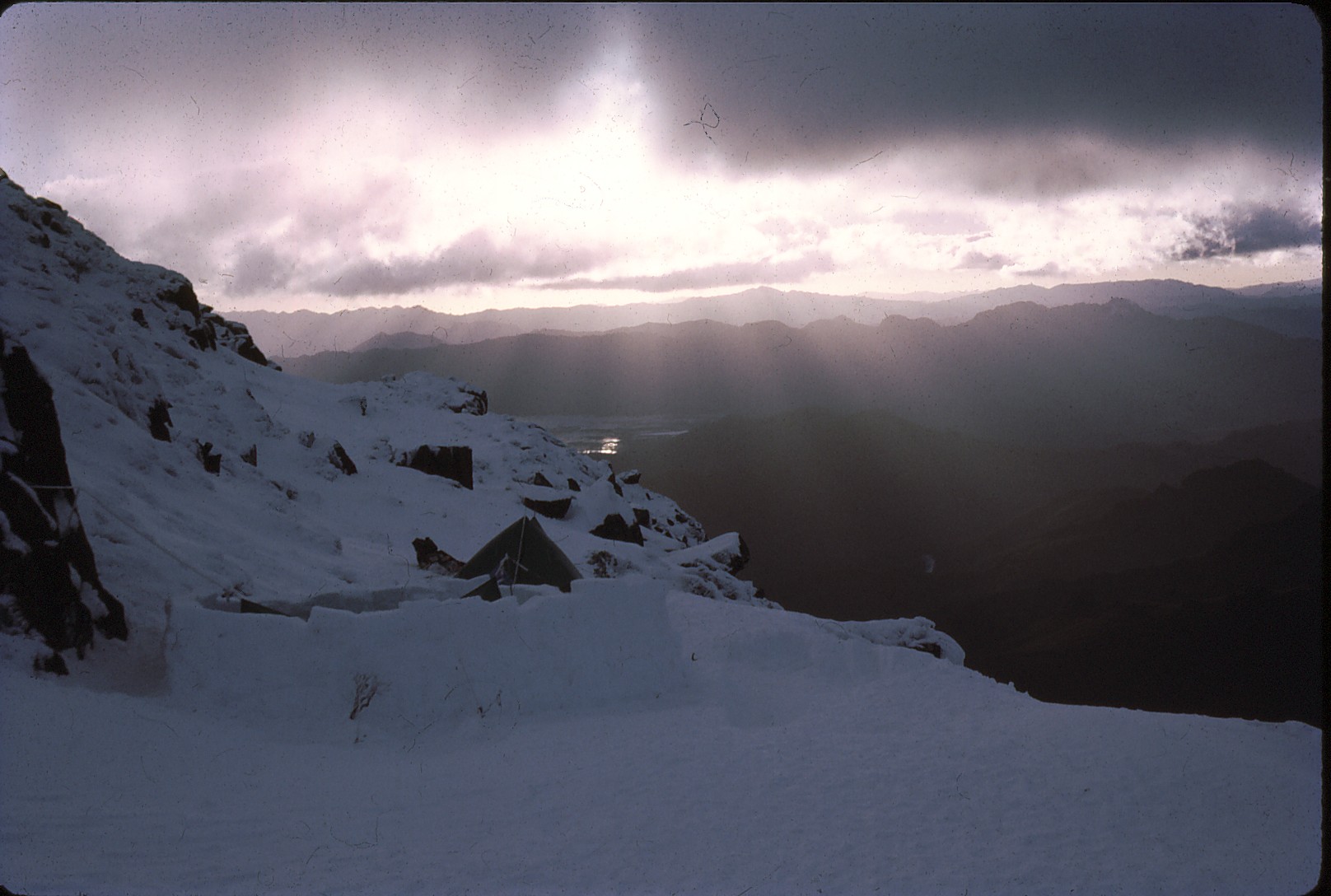
A year and a half before the opening, Stefan Karpiniec photographed a winter camp on Mount Eliza during a Tasmania University Mountaineering Club outing to Mount Anne. His August 1972 photograph shows dark tents set into snow with distant ridges behind them.