
First Recorded Ascent
O. Phillip Dickert's account in the 1936 Mountaineer annual documents the expedition that reached the summit in September of that year. His party included Jack Hossack and George McGowan, and Dickert's narrative constitutes the primary record of that climb. A 1963 American Alpine Journal entry describes an ascent of the distinct West Peak, a separate objective from the main summit and documented as a later achievement.
Geology of the Picket Range
The U.S. Geological Survey identifies quartz diorite and granodiorite among the principal rock types in the precipitous northern reaches of North Cascades National Park, the broader geological province that includes the Picket Range. These crystalline rock units contribute to the extreme steepness characteristic of the range. No single rock formation has been assigned to the Challenger summit specifically without a detailed geological map of the immediate peak.
Challenger Glacier and the Aerial Record
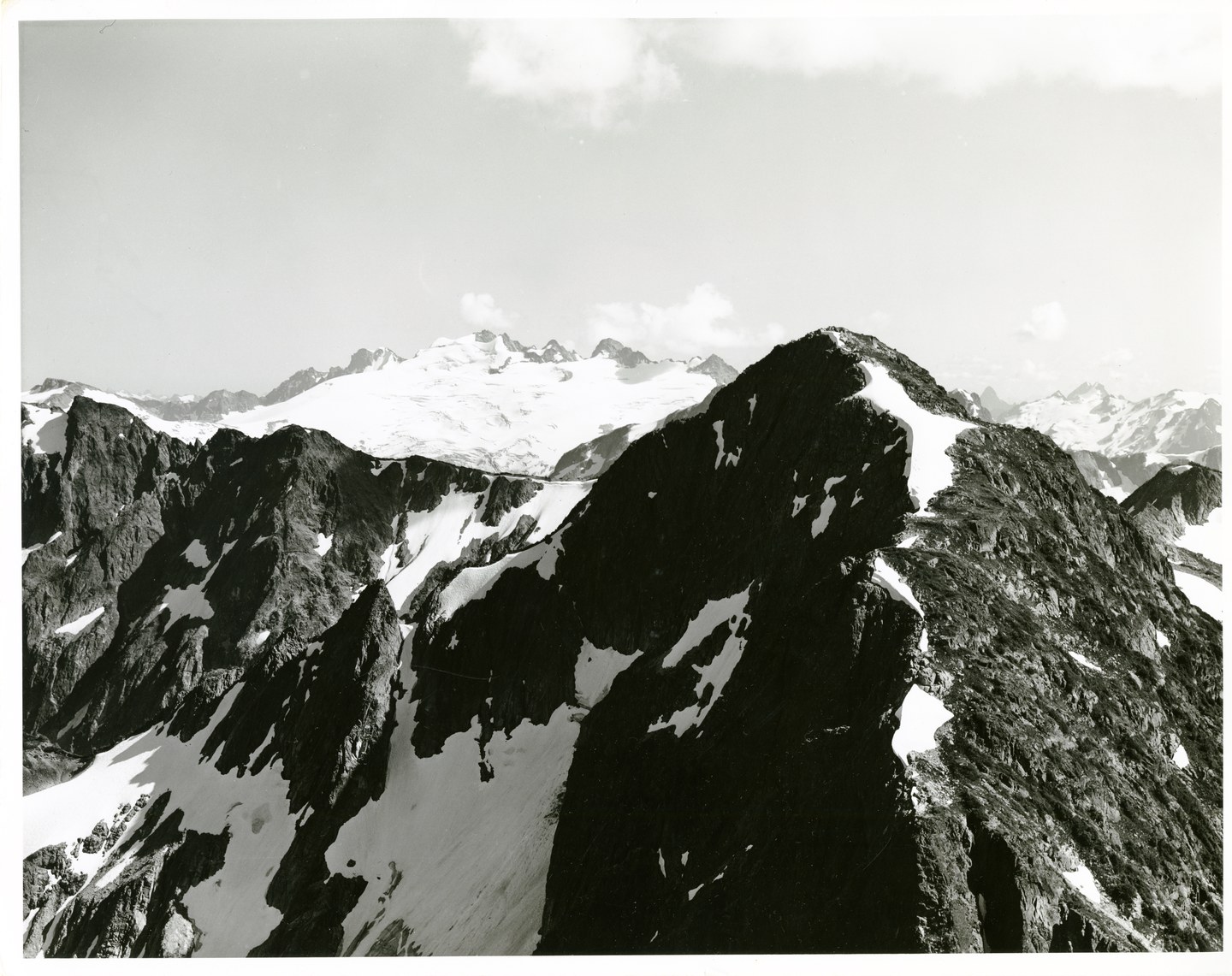
The Challenger Glacier lies below the mountain proper and appears clearly in a 1963 National Park Service aerial survey that also captures Red Face Mountain in the foreground and other Picket Range features beyond. The NPS uses photographic records of this kind to track glacial conditions over time. The glacier and the summit's steep rock faces together constitute the landscape that distinguishes Mount Challenger within the northern Picket Range.