
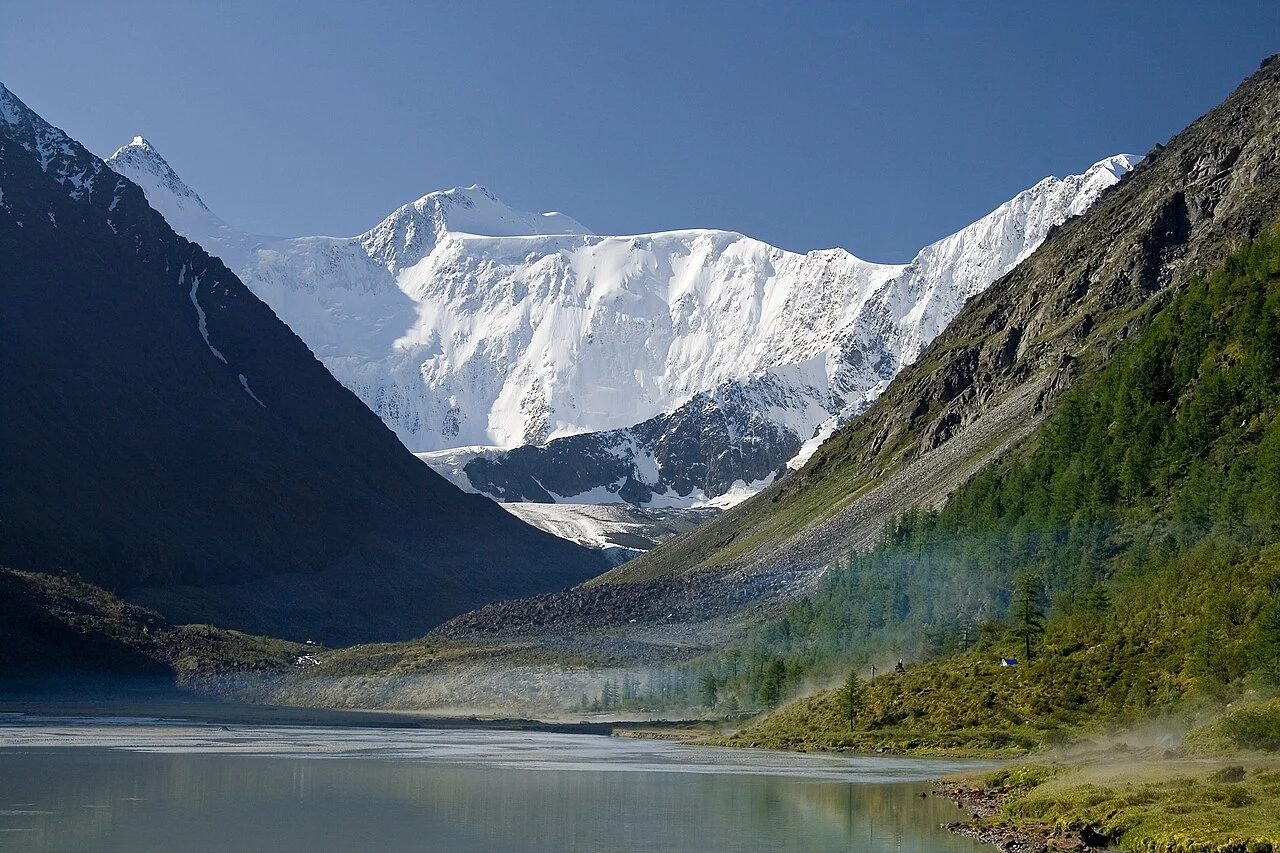
Twin summits and glacial terrain
The East Summit at 4,506 metres is the range high point and the principal subject of documentation. The West Summit reaches 4,435 metres according to Katon-Karagay District accounts. A saddle between the two summits lies at approximately 4,000 metres. The northern face descends toward the Akkem Glacier and the Akkem valley, while the southern slopes fall toward the Katun Glacier on the opposite aspect.
The Tronov brothers and Altai research
Brothers Boris and Mikhail Tronov documented the first ascent of the East Summit in 1914, as recorded by the Tomsk Regional Museum. Mikhail subsequently conducted glaciological fieldwork in the Altai glaciers in 1924 and 1926, research that the Tomsk Regional Museum documents separately from the 1914 climb.
Kazakh name, sacred tradition, and UNESCO inscription
In Kazakhstan the mountain is known as Muztau, with the Abai Institute recording a sacred tradition associated with the name and attributed to local communities. The 1998 UNESCO Golden Mountains of Altai inscription is a serial property whose three Russian components include the Katunsky Zapovednik and a buffer zone around Mount Belukha.