
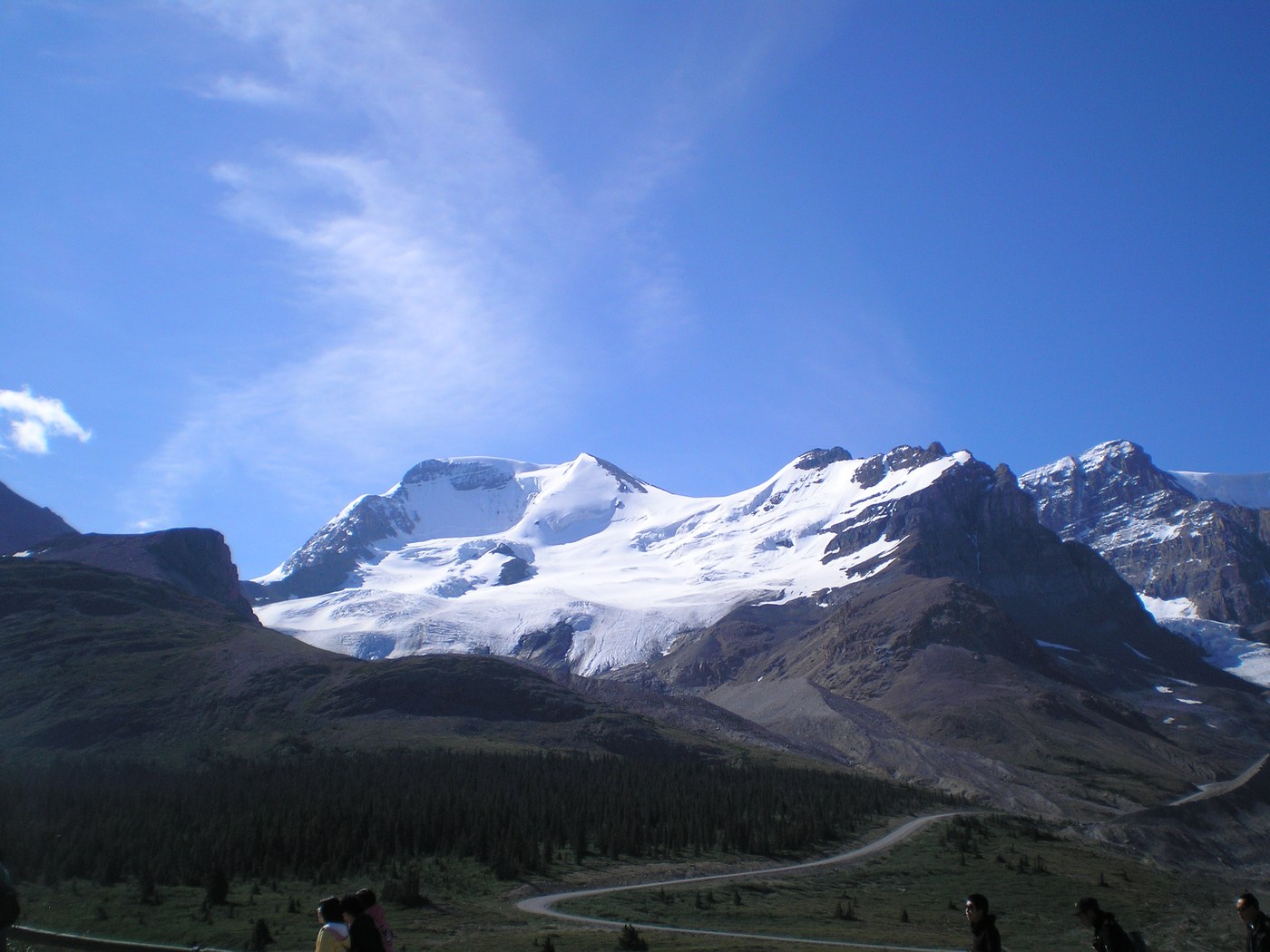
First Ascent and the Columbia Icefield
In 1898 the British climber Norman Collie and his companion Hermann Woolley completed the first recorded ascent of Mount Athabasca. From the upper reaches of the peak they looked out over the Columbia Icefield, an observation that helped establish its scale and significance within the broader geography of the Rockies. The climb belongs to a period of intensive mountaineering exploration in the range, undertaken in collaboration with Indigenous peoples and local guides whose knowledge of these landscapes predated any formal expedition.
The Columbia Icefield, of which the Athabasca Glacier is the most accessible outflow, lies immediately below the peak's southern aspect. That relationship between summit and icefield gives Mount Athabasca a particular cartographic importance: it is both a high point in its own right and a vantage from which the broader ice complex becomes legible.
The Athabasca Glacier and Its Landforms
The Athabasca Glacier descends from the icefield over three distinct bedrock steps, a staircase topography that produces visible changes in the glacier's surface texture and slope as it moves downvalley. It is a separate geographic feature from the mountain itself, though the two share a name and are visually inseparable from the main viewpoints along the Icefields Parkway.
Moraine deposits and the documented position of the glacier's ice front together provide evidence of the glacier's retreat over time. These landforms — lateral and terminal moraines left as the ice has pulled back — form a physical record of glacial change that sits alongside the living ice, giving the valley floor a layered quality that spans centuries of advance and withdrawal.
Position in the Rockies Landscape
At 3,491 metres, Mount Athabasca is a prominent landmark within a region defined by high glaciated summits and deep river valleys. The Athabasca River, one of the major drainages of western Canada, takes its name from the same Cree-language root as the mountain, connecting the peak linguistically to the broader watershed it overlooks. That naming relationship reflects the long presence of Indigenous peoples in this landscape before the era of European mountaineering.