
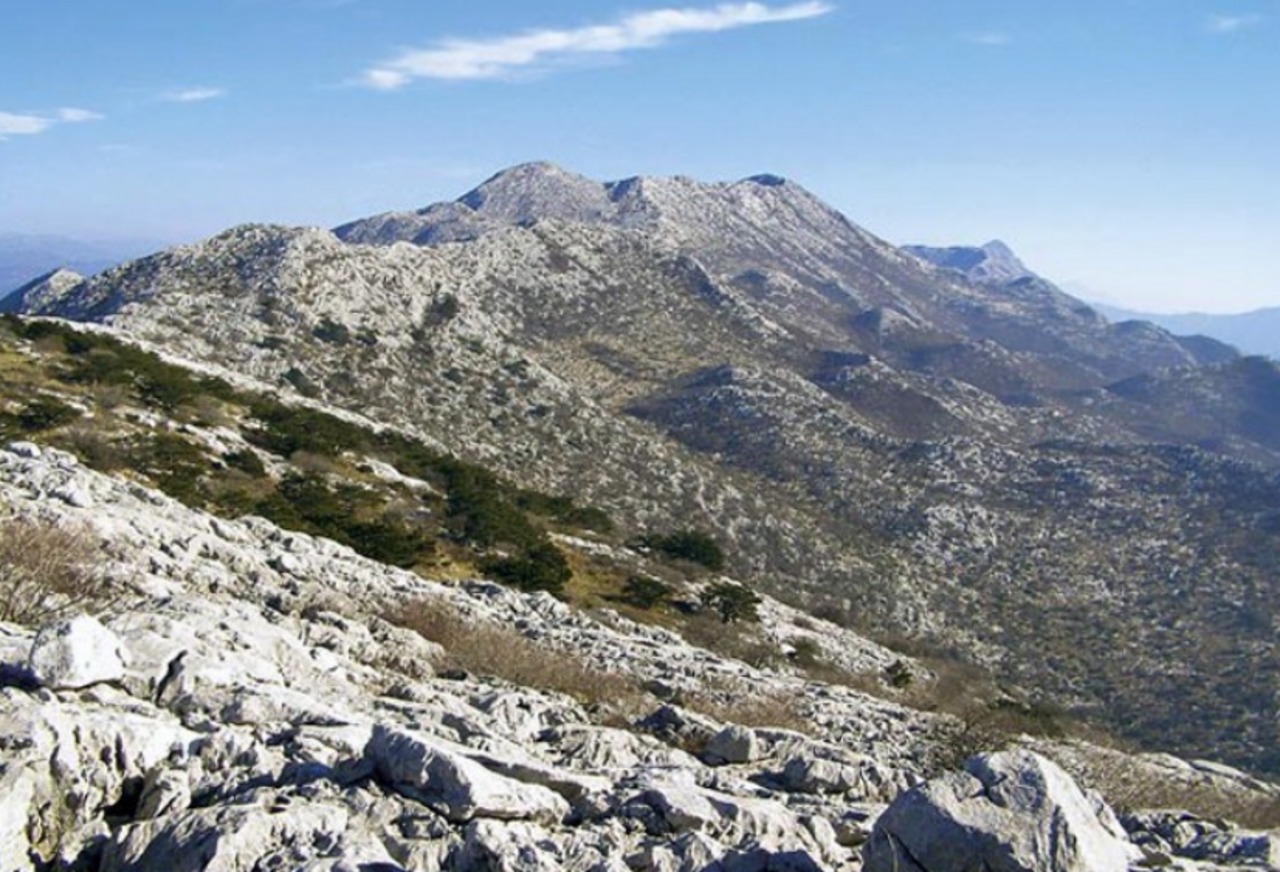
Rock and Karst
The Croatian Encyclopedia records Cretaceous limestone, dolomite, and flysch across the Mosor massif. Rainwater entering fractures in the carbonate bedrock widens them over time, forming karst cavities. Vranjača Cave, located near Kotlenice, is among the documented results of this process.
Vranjača Cave and Early Research
Local records document that naturalist Umberto Girometta visited Vranjača to study cave fauna in 1913, 1914, and 1921. The cave was formally opened to the public on 15 December 1929 in a ceremony attended by the HPD Mosor mountaineering club and local residents.
Ridge Summits
Veliki Kabal is the highest named summit on Mosor. The Croatian Encyclopedia identifies several distinct points along the ridge: Mosor, also known as Ljubelj, at 1,331 m, Sveti Jure at 1,319 m, and Ljubljan, each carrying a separate identity from Veliki Kabal.