
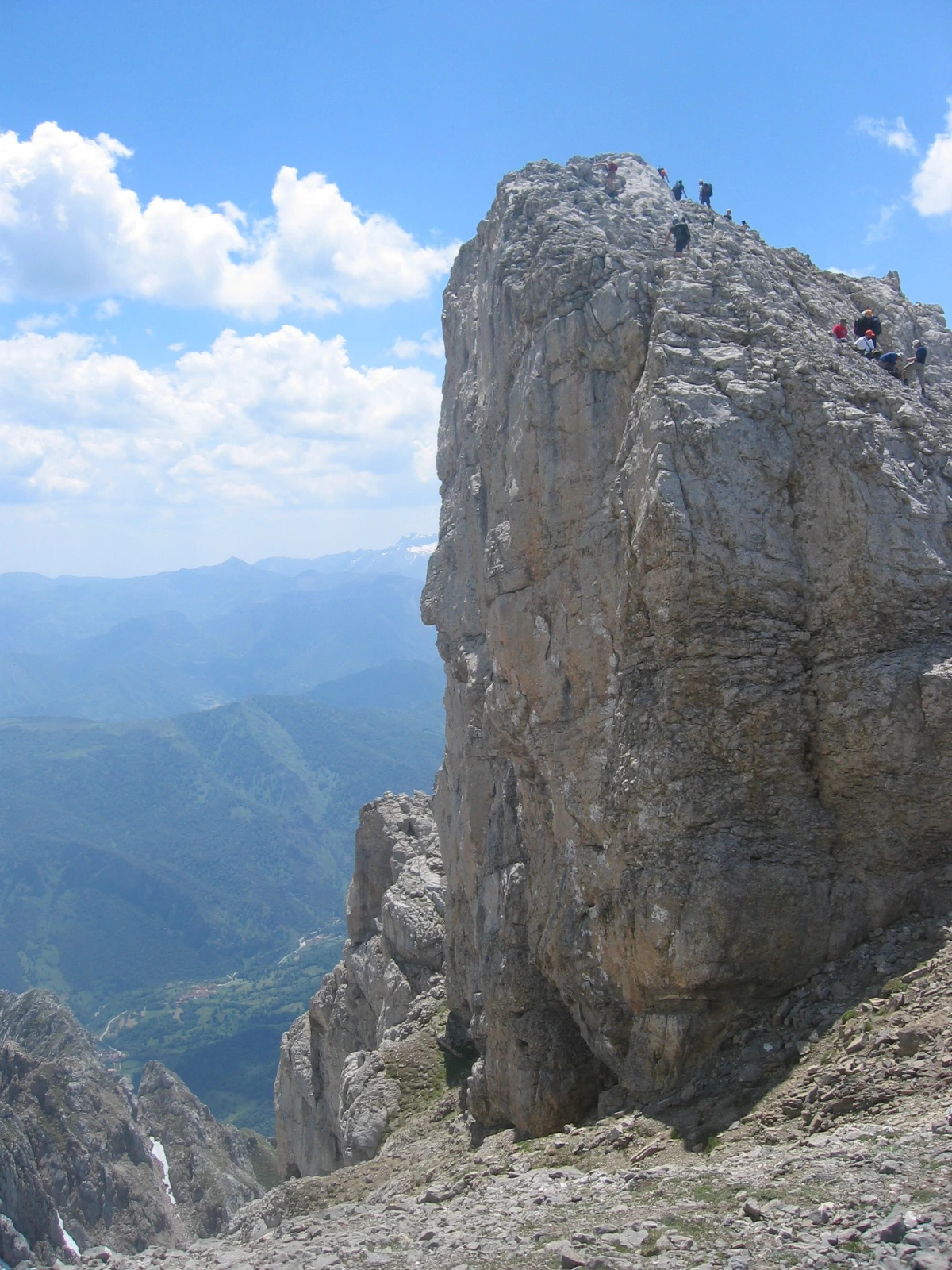
The limestone block above Liébana
In César Acebal’s photograph, people on the final rock face give a sense of scale to the summit block. Carboniferous limestone dominates the Picos de Europa. Across the massif, water seeping through fractures has dissolved the rock into karst forms, while glaciers carved valleys and basins during the Quaternary.
The eastern massif is the smallest of the three that make up the range. The summit block rises close to other high points of Ándara, but the National Parks Agency identifies Morra de Lechugales as its highest peak.
An ascent recorded in 1890
On 7 July 1890, Aymar de Saint-Saud reached the summit with Cotera, a man from La Hermida, and a miner from Ándara. In the French Alpine Club’s 1893 yearbook, Saint-Saud and Paul Labrouche report an elevation of 2,445 metres and describe the top as a block of rock. They wrote that the highest peak was absent from the maps they had used.
In that report the peak appears as “Tabla de Lechugales”. The modern national gazetteer and the names collected from local residents place La Tabla on a separate feature below the summit.
Mine roads across Ándara
The miner on that ascent worked in a massif already connected by ore roads. In 1856 the company La Providencia began developing Ándara’s zinc deposits. Spain’s Geological and Mining Institute traces the workings to the Ándara meadows and the slopes of Pico San Carlos.
Mining in this sector continued intermittently until 1975. Roads cut into the slopes to carry ore still mark the landscape. The 1890 ascent account preserves a trace of the knowledge of the massif that those workers brought to early mountaineering expeditions.