
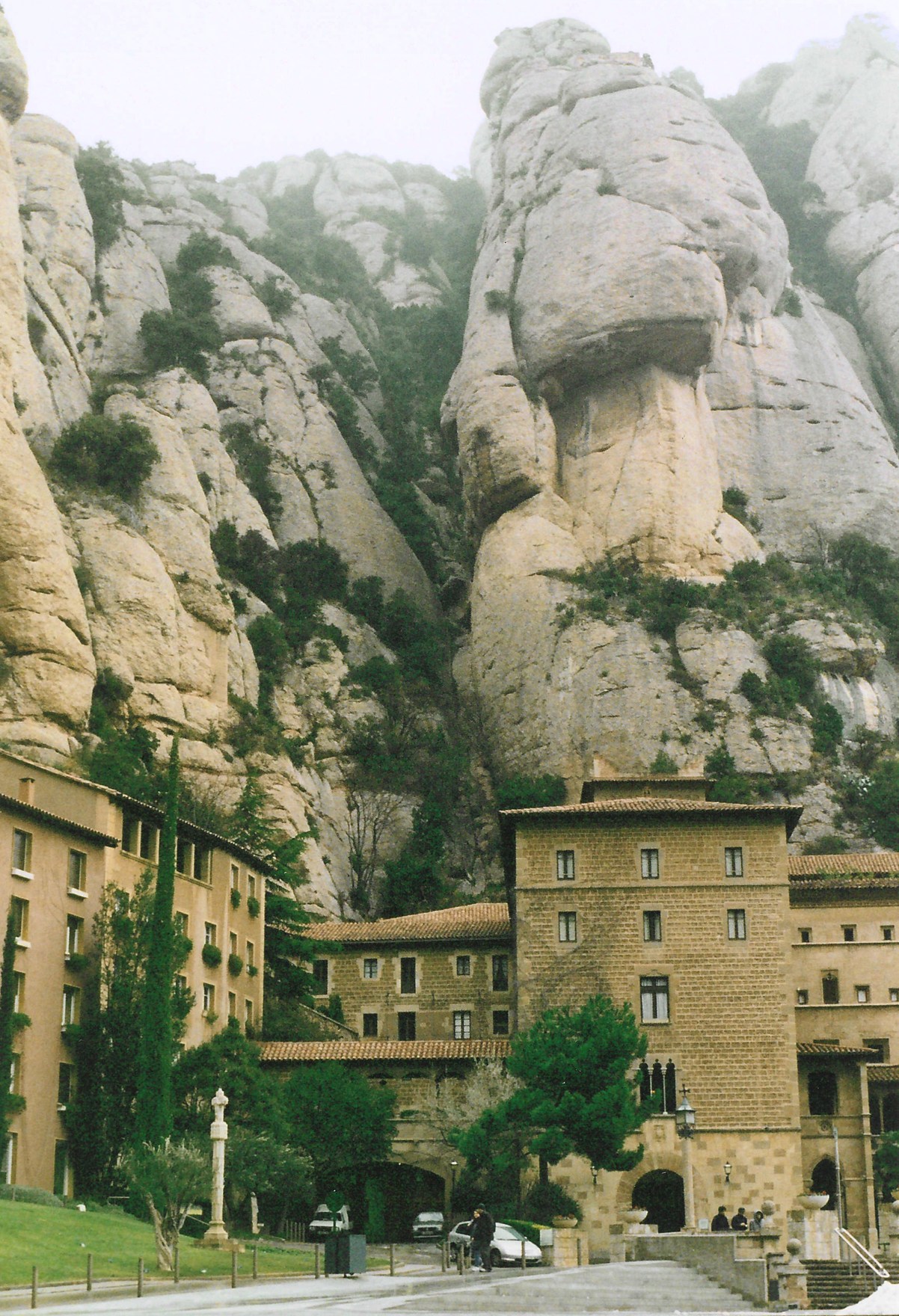
Eocene conglomerates, present-day pinnacles
The rock that makes up Montserrat is a conglomerate formed from alluvial fan and delta deposits during the Eocene. Over time, these sediments consolidated into a rock mass of uneven resistance: the more cemented sectors withstood erosion more effectively, while the softer materials retreated more rapidly. The result of this differential erosion, sustained across geological epochs, is the pillars, needles, and vertical walls that characterise the massif today. It is important to distinguish between the age of the sediments, which were deposited in the Eocene, and the present landscape, which is the product of a much later erosive process.
Among the most recognisable forms are the Cavall Bernat, a needle with an unmistakable profile that stands out against the western horizon, and the Agulles group, a cluster of pinnacles in the southern sector of the massif. The Coll de Migdia provides the topographic link between different sectors of the relief and serves as a reference point on the high-altitude routes. Each of these forms is testimony to an erosive history that began long after the conglomerates had finished being deposited.
The monastery: foundation, independence, and restoration
The Montserrat Abbey does not occupy the summit of the massif but one of its flanks, integrated into the topography at an intermediate elevation. According to the history recorded by the abbey itself, the monastery was founded in 1025 by Bishop Oliba, although eremitic presence and worship at the site predate that foundation. In 1409, Montserrat was granted the status of an independent abbey, which consolidated its position as a religious institution of the first order within the Catalan and Mediterranean context.
The history of the monastery is not, however, an unbroken trajectory. The wars and upheavals of the eighteenth and nineteenth centuries caused severe damage to the monastic complex and led to periods of abandonment. The restoration of monastic life took place in 1844, from which point the Benedictine community resumed the religious, cultural, and publishing activity that characterises it today. The distinction between the history of the monastery and that of the ascent to Sant Jeroni is relevant: pilgrimage to the sanctuary and an excursion to the summit are two experiences with their own logic, even though they share the same territory.
Sant Jeroni and the ascent from the monastery
The route leading from the monastery to the summit of Sant Jeroni, described in materials published by the Patronat de la Muntanya de Montserrat, crosses the northern face of the massif, gradually gaining elevation among the conglomerates and the high-altitude Mediterranean vegetation. The summit, at 1,236 metres, offers a panorama stretching from the plains of the Vallès and the Bages to, in favourable visibility conditions, the Pyrenees to the north and the sea to the south.
This route connects, within a single itinerary, the two dimensions that define the singularity of Montserrat: the geological, with the conglomerate rock ever-present in walls and needles, and the cultural, with the monastery as the starting point and constant visual reference throughout the ascent. Sant Jeroni is the highest point of the massif, but the mountain as a whole is difficult to understand if its natural and historical dimensions are separated.