
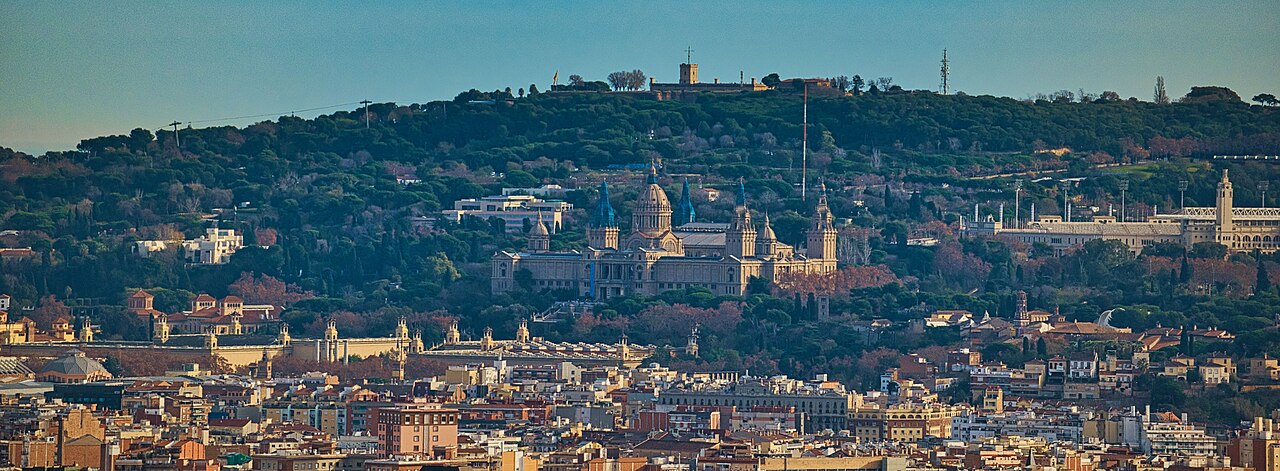
Geology and quarries
The hill is formed of Miocene siliceous sandstone — gres in Catalan — a material used in Barcelona's buildings since Roman times. Research distinguishes evidence of pre-Roman extraction from the earliest fully identified workings, which date to the Roman period. The geological inventory of the Generalitat de Catalunya lists the site as geozone 344 for the accumulated traces of centuries of quarrying activity, which reshaped the slopes and left escarpments and terraces still visible today.
From the farell to the castle
A medieval watchtower known as the farell already stood on the summit when, in 1640, at the outbreak of the War of the Reapers, the municipal government ordered a fort to be built around it. The conflict lasted until 1652, and the complex continued to grow until it became a permanent fortress. The municipal interpretation centre at the castle documents the facility's repressive use across different historical periods.
The 1929 Exposition and the 1992 Olympic Games
The 1929 International Exposition transformed the slope facing the Plaça d'Espanya; the stadium was inaugurated within that framework on 20 May of that year. The venue was extensively remodelled for the Barcelona Olympic Games, whose opening ceremony took place on 25 July 1992. The mountain thus retains the overlapping marks of the historic quarries and of the urban development brought about by both major events.