
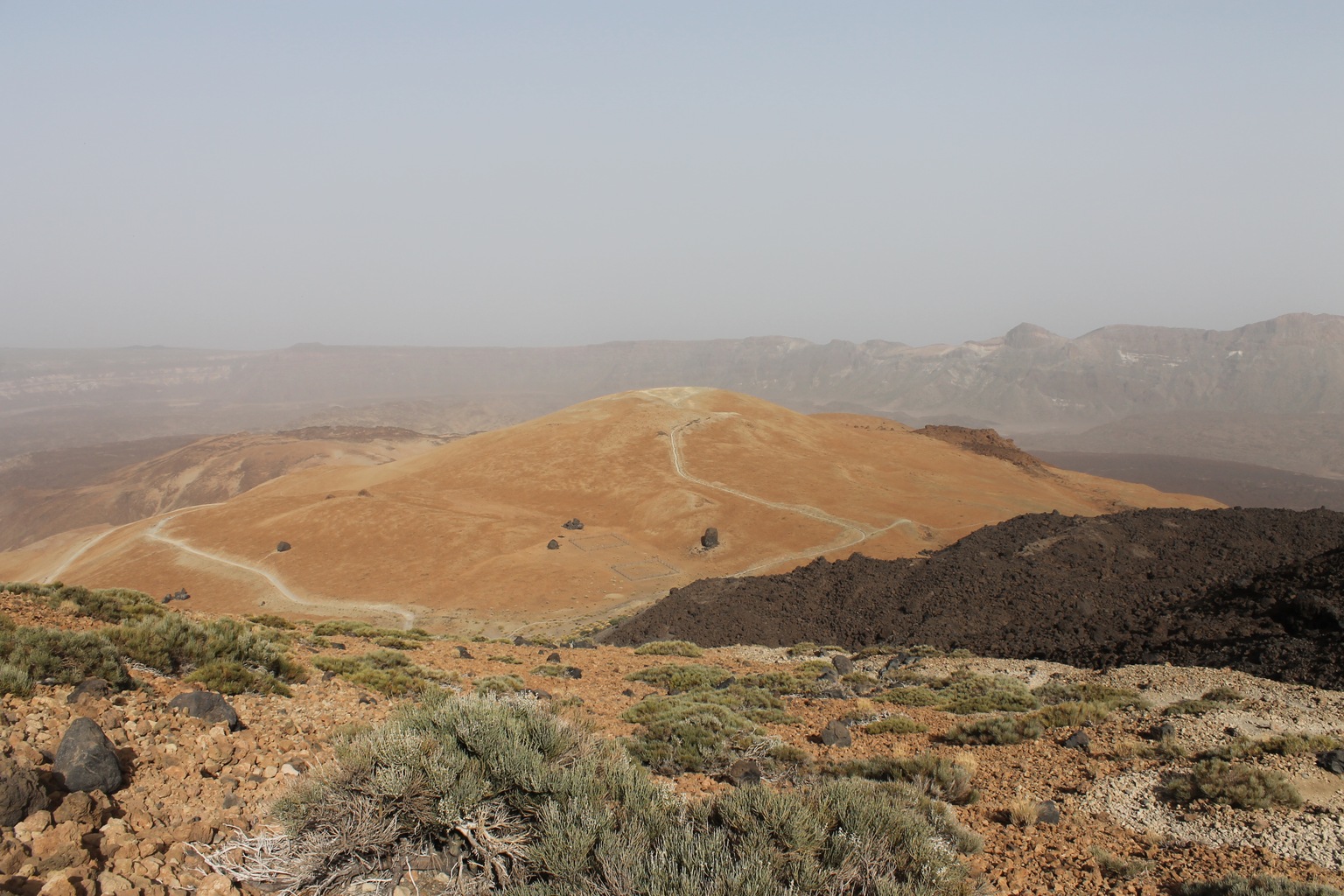
Three phases of a fissure eruption
Approximately 2,000 years ago, a fissure on the eastern flank of Teide gave rise to a three-phase episode. First, phonolitic lava emerged effusively. Next, a sub-Plinian explosion dispersed ash and pumice across the surrounding area. Activity concluded with a renewed emission of lava and pyroclasts accompanied by the growth of the dome that defines the outline of the complex today.
Pumice, obsidian and the Teide Eggs
The episode left two distinct materials: the pale pumice deposits from the explosive phase and the black obsidian flows linked to the dome. The Teide Eggs are large rounded blocks that originate from the lava flow front of Teide and acquired their shape by rolling down the slope.
Human traces: pumice and high-altitude logistics
Las Minas de San José was an open-pit operation dedicated to the extraction of pumice from the sub-Plinian episode; its name lives on in the viewpoint situated at that same location. On the upper part of Montaña Blanca, at 2,724 m, the Puesto de Mulas is preserved, a structure that the Government of the Canary Islands regards as a historic infrastructure.