
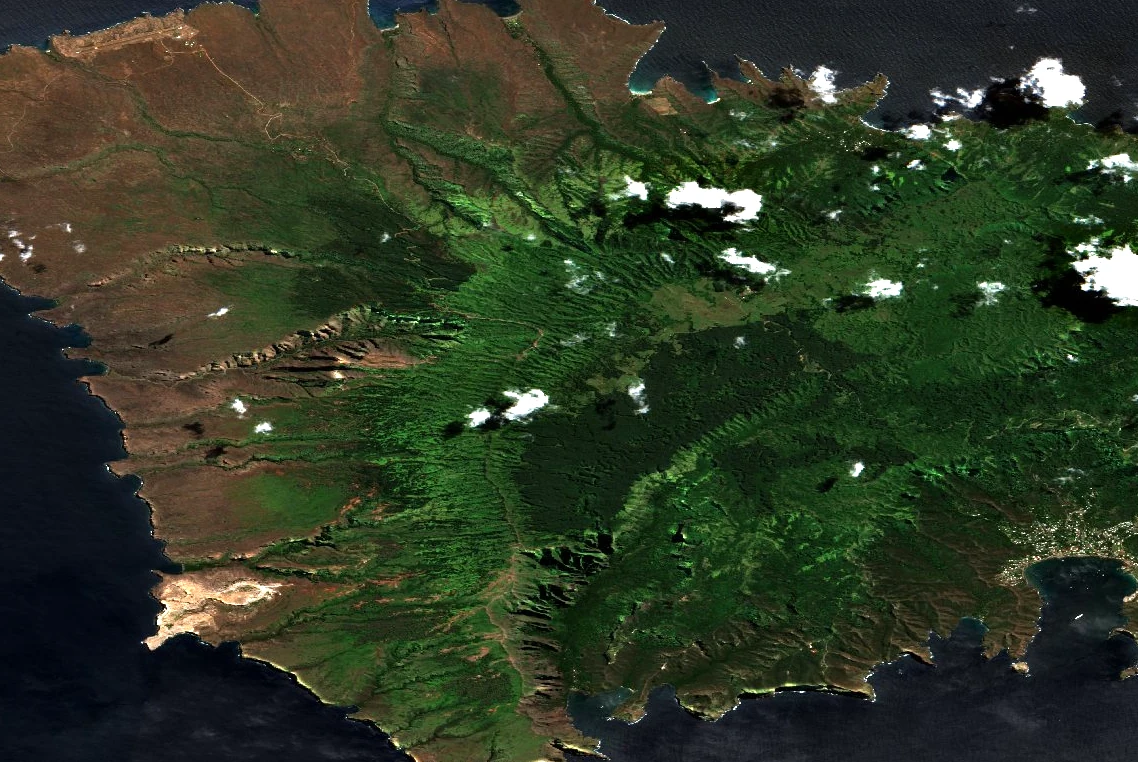
Volcanic Architecture
Tekao’s shield makes up more than half of Nuku Hiva. The BRGM geological synthesis dates its above-water tholeiitic basalt flows to about 4.52–3.83 million years ago. Some flows preserve the ropy surfaces typical of pāhoehoe lava. Much of the old shield collapsed, and lava from the younger Taiohae volcano later filled its caldera. The outer ridge and the lower Tōviʻi plateau help make this sequence visible at island scale.
High-Elevation Research
A jumping spider collected by Rosemary Gillespie at about 1,200 m on 23 June 2000 became the reference specimen for Hivanua tekao. Gillespie and L. Shapiro collected a female the same day at a recorded elevation of 1,185 m. Both records come from Mount Tekao, whose higher slopes include wet montane forest. Wayne P. Maddison formally described the species in ZooKeys in 2024.
UNESCO Recognition
On 26 July 2024, UNESCO inscribed Te Henua Enata – The Marquesas Islands as a World Heritage property spanning seven groups of sites. French Polynesia’s Department of Culture and Heritage lists the Te-Kao–O’oumu–Matahamo sector in the Nuku Hiva component. Across the property, the protected areas connect upland ridges with valleys and parts of the coast, reflecting the way Marquesan communities organised their land around valleys.