
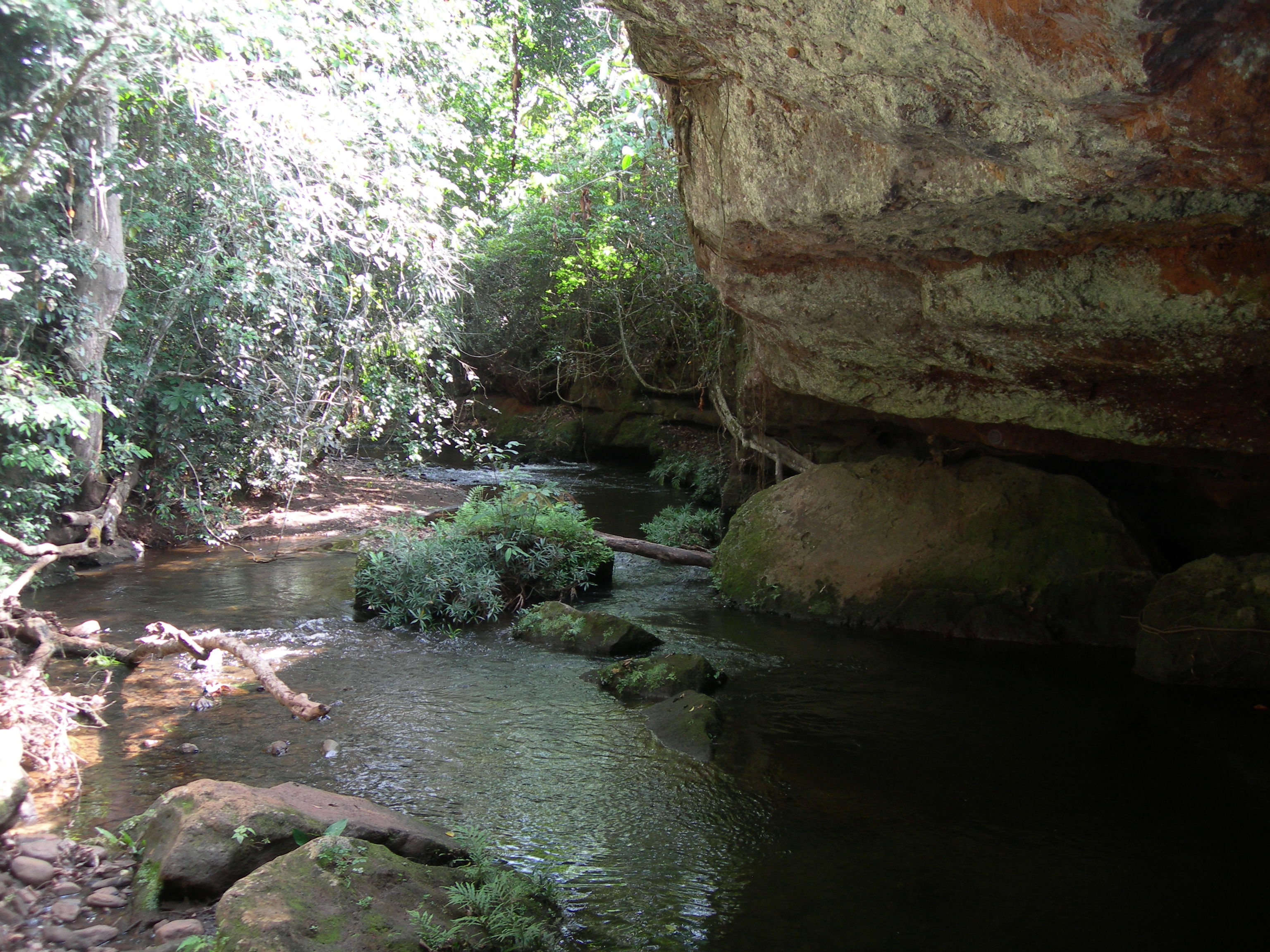
Quartzite Ridge and Drainage
The Nimba crest is underlain by iron-rich quartzite that resists erosion more than many surrounding rock types, producing a steep upper ridge flanked by abrupt slope transitions. Runoff from this crest feeds numerous headwaters — UNESCO records approximately fifty across the two-country World Heritage property — channeling water into the forested ravines of the lower Ivorian slope before reaching broader valley floors.
The lower slopes carry closed-canopy woodland that follows stream corridors, while upper elevations open into montane grassland. This vertical sequence compresses distinct plant communities into a relatively short altitudinal span, and the boundary zones between forest and grassland recur throughout the Ivorian sector at ecotones that researchers have used as reference sites.
Protected Status and Administration
A strict nature reserve was established in 1944 following early scientific surveys of the massif. Naturalist Raymond Schnell published one of the early field descriptions of its vegetation in 1950. Guinea's sector was inscribed as a UNESCO World Heritage site in 1981. Côte d'Ivoire's extension was added in 1982. The Ivorian Office of Parks and Reserves, OIPR, was created by a decree issued in July 2002 and now administers the national sector.
A joint conservation report on work in 2019 documented an Ivorian monitoring strategy discussed with representatives of Guinea’s CEGENS. Discussions took place in August of that year and field monitoring began the following December. The same report identifies four community forests adjacent to or near the reserve — Gbapleu, Yéalé, Bouan-houyé, and Danipleu — as part of the broader conservation landscape on the Ivorian side.
Amphibian Survey, 2018–2019
Kanga and co-authors conducted systematic amphibian surveys from 18 June 2018 to 17 May 2019. In forested ravines with cascading streams, observers documented the torrent frog Odontobatrachus arndti, including at a waterfall site bordered by savannah at 847 metres.
At lower agricultural margins near Yéalé, researchers heard the calls of Hoplobatrachus occipitalis in rice paddies at night, extending the survey's coverage into human-modified habitats. At the opposite end of the gradient, Nimbaphrynoides occidentalis was recorded in montane grassland. This toad is notable for bearing live young, an unusual reproductive mode among anurans.