
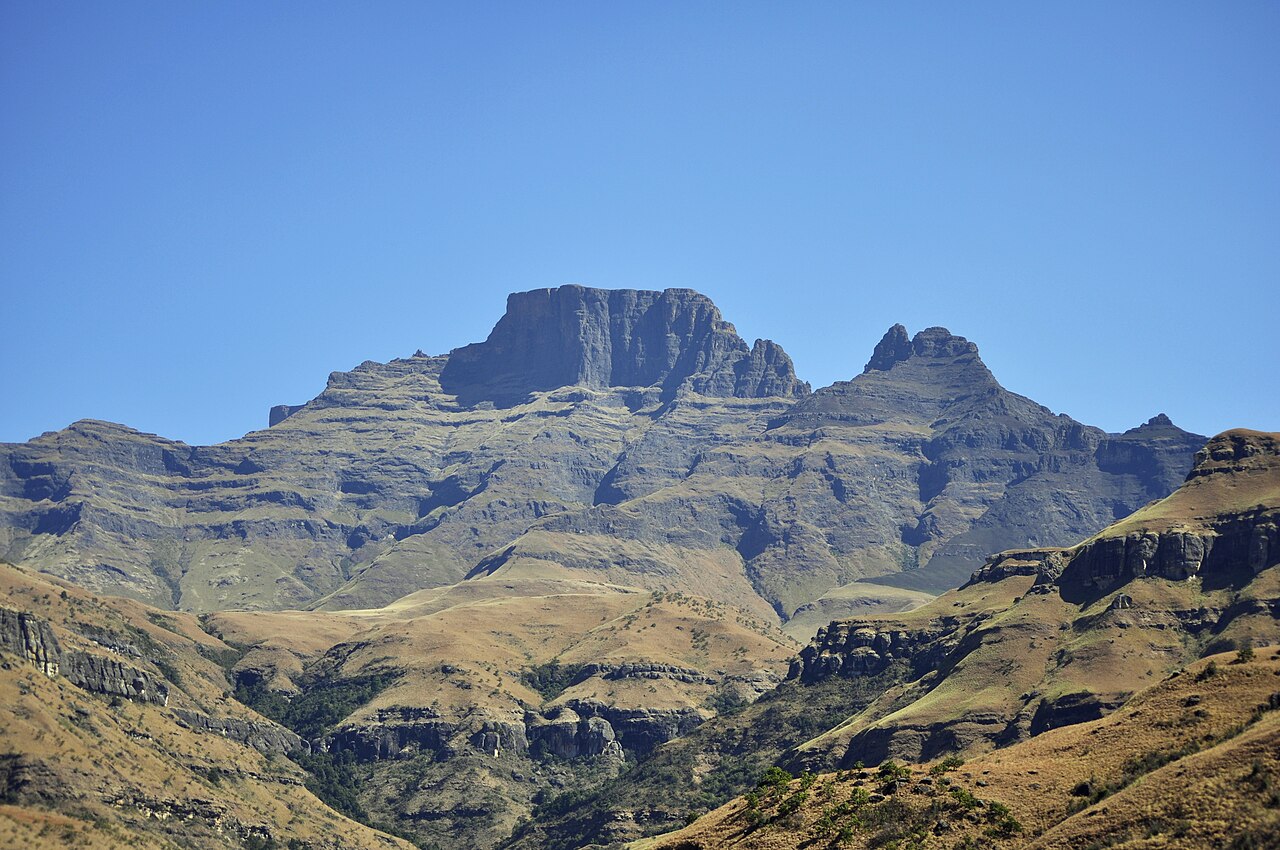
Form and Position Along the Central Escarpment
The peak occupies a defined gap in the central Drakensberg chain, where the escarpment breaks into individual spires rather than a continuous wall. Its hooded profile, which gives the peak its name, is formed by a cap of resistant basalt sitting above steeply eroded lower flanks. A 1937 photograph published in the Alpine Journal depicted Monk's Cowl and noted it as unclimbed within the climbing record of that period.
The 2004 American Alpine Journal Account
A firsthand climbing report by Janschek, Mackenzie, and Manson appeared in the 2004 American Alpine Journal, documenting an ascent of Monk's Cowl and describing the character of its rock architecture. The account recorded the quality and configuration of the basalt faces encountered during the climb, contributing a detailed observational record to the documented mountaineering history of the peak.
World Heritage Designation and Conservation Context
The Drakensberg range was inscribed as the uKhahlamba–Drakensberg Park UNESCO World Heritage Site in 2000, recognising its outstanding natural and cultural values. Monk's Cowl falls within this designated landscape. The Ezemvelo KZN Wildlife authority administers the Monk's Cowl reserve area at the base of the peak as a managed conservation zone within the broader protected area.