
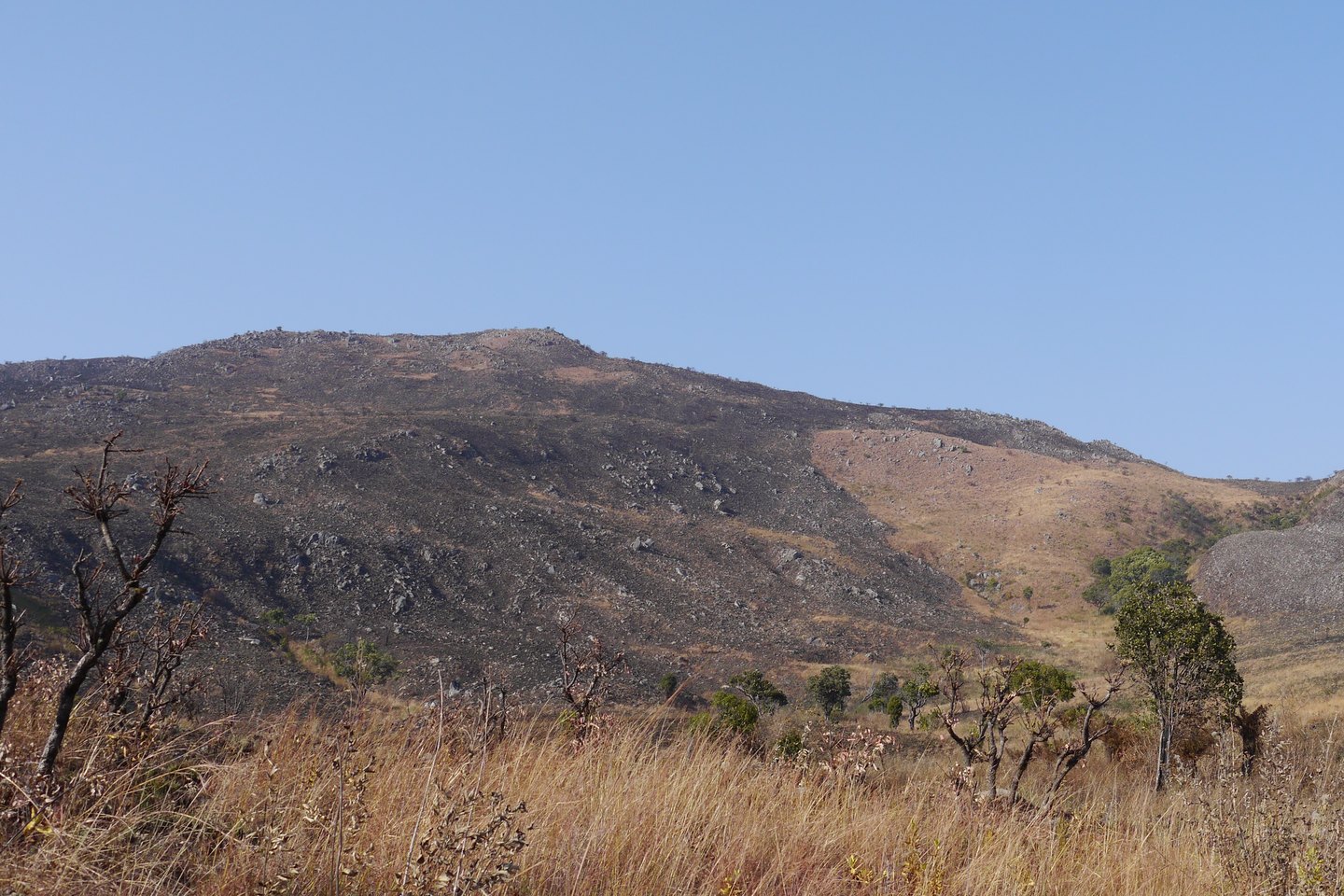
Summit and geographical setting
Located in the municipality of Londuimbali in Huambo Province, Morro do Moco is recorded by the Angolan Council of Ministers and the Universidade José Eduardo dos Santos at an approximate altitude of 2,620 metres, placing it as the highest point in the national territory. The official designation used in legal instruments and institutional profiles is Morro do Moco, with "Morro" referring to the summit itself, while "Serra do Moco" denotes the broader orographic unit in which it sits.
The distinction between summit and range is relevant for understanding the extent of the area in question: the afromontane forest remnants are distributed across the entire range and are not confined exclusively to the peak. This dispersal explains why conservation policies cover a considerably larger territory than the isolated summit.
Afromontane forest and ecological value
Around thirty patches of afromontane forest have been identified in the Serra do Moco, a figure cited in the preamble to Law No. 5/26, which illustrates the fragmentation characteristic of this type of high-altitude vegetation cover. These fragments are recognised as being among Angola's principal afromontane remnants, giving the range an ecological significance that extends beyond the regional level.
Afromontane forest, typical of elevated zones across the African continent, is distinguished by a floristic composition adapted to the altitude, temperature, and rainfall conditions of the central plateau. Its preservation in dispersed patches represents both a testament to the region's original cover and an ongoing challenge for integrated land management.
Legal protection and conservation area
Law No. 5/26, published on 9 April 2026 in the Diário da República, formally establishes the Serra do Moco Conservation Area, classified as a Partial Nature Reserve. This legal instrument represents the official recognition by the Angolan state of the range's natural value and sets out the legal framework for its management. The legislation identifies fires and the use of natural resources among the pressures bearing on the area, without specifying particular species or establishing specific restrictions in the text examined.
The creation of the reserve is part of a broader process of conservation planning in Angola, in which the formal classification of sensitive areas seeks to create conditions for sustained long-term management. The status of Partial Nature Reserve allows, in principle, for conservation objectives to coexist with certain forms of land use, with subsequent regulations to define the respective limits.
Research and integrated management
ISCED-Huambo, in partnership with other units of the Universidade José Eduardo dos Santos, has launched an integrated management project for Morro do Moco that links scientific research with conservation action. The initiative positions the university as a central actor in the production of knowledge about the range's ecosystem and in formulating responses to the identified environmental pressures, namely fires and resource use.
The convergence of the new legal framework established by Law No. 5/26 and the research capacity of UJES and ISCED-Huambo suggests an approach that combines regulatory instruments with a local scientific foundation. The continuation of this project will be decisive in deepening knowledge of the range's biodiversity and in informing management decisions for the Serra do Moco Conservation Area in the years ahead.