
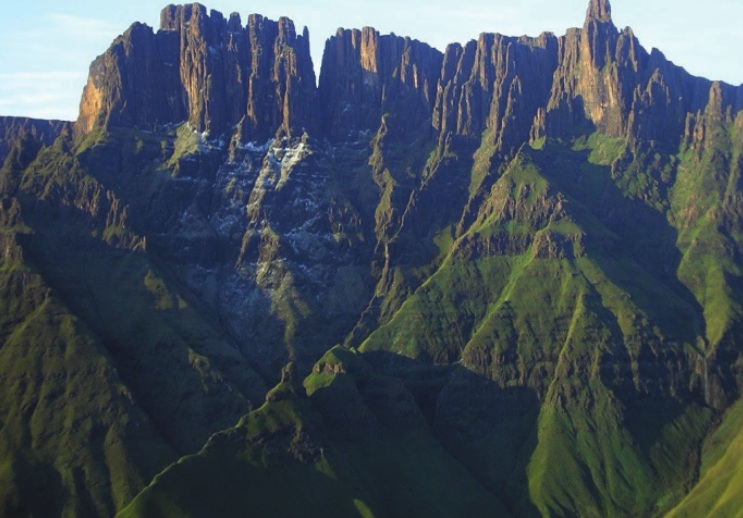
Form and Escarpment Setting
The cutback presents as a pronounced concave indentation in the cliff line rather than a discrete summit. The surrounding walls rise through the layered basalt and sandstone sequence that UNESCO's Maloti–Drakensberg Park inscription identifies as characteristic of the range's geological profile. This stacked stratigraphy governs the stepped, recessed form visible across the Mnweni face.
Mnweni and Ntonjelana Valley Erosion
Malcolm Pearse's 1973 survey in the Alpine Journal documents the Mnweni and adjacent Ntonjelana drainages as deeply incised valleys that have driven the progressive retreat of the escarpment edge. Persistent stream action along these corridors has undercut the basalt cap, producing the sharp embayments and isolated pinnacles that define this part of the northern wall.
Nomination History and Conservation Sector
The World Heritage nomination submitted to UNESCO describes the Mnweni section as an intervening sector connecting the original northern and southern nominated components, with the documentation noting its role in the continuity of conservation values across the range. The nomination records this relationship historically. No current designation inference for the Mnweni sector is drawn from that account.