
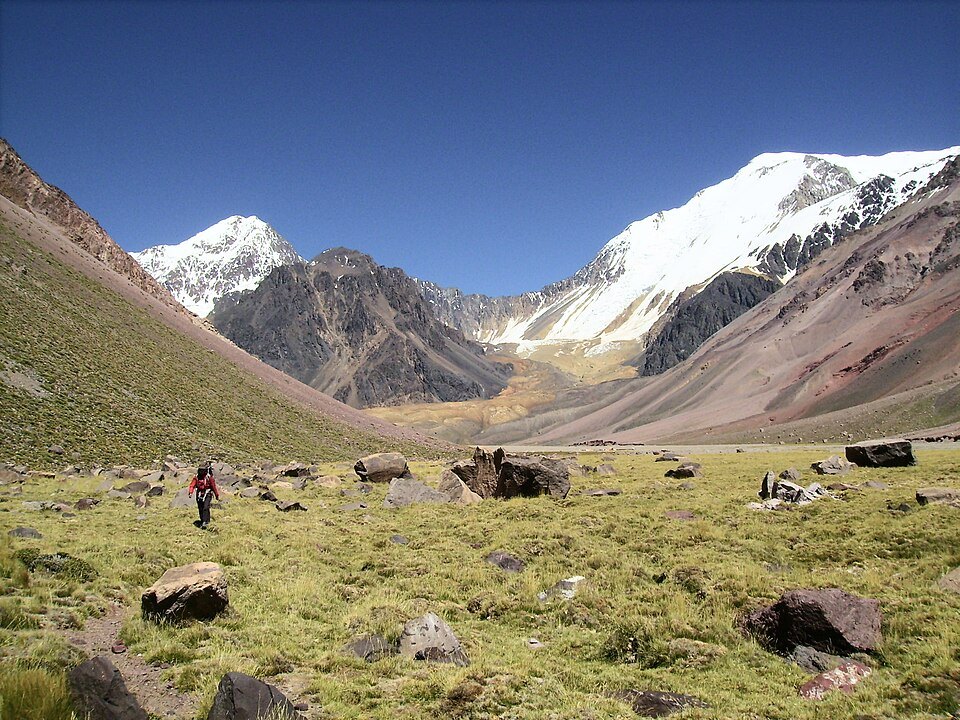
The Cordillera de la Ramada and the Place of Mercedario
The Cordillera de la Ramada is a distinct Andean range, clearly differentiated from the Aconcagua massif that rises further to the south. Within this group, Mercedario shares the skyline with Cerro Ramada, a neighbouring and also significant summit, but one with an independent name and geographic identity. The Valle Colorado, visible from the lower slopes, frames the mountain within a landscape of arid quebradas and broad alluvial terraces characteristic of the San Juan precordillera, as shown in satellite imagery from CONAE's Terra MODIS sensor.
The proximity to Calingasta has made Mercedario a visual and cultural landmark for the communities of the western piedmont of San Juan. Its mass, visible from the floor of the valley of the same name, structures local geography in a way that transcends the purely alpine scale: the mountain forms part of the everyday horizon of a region where extreme altitude and aridity define both the landscape and the ways of life.
The First Documented Ascent of 1934
The modern sporting record of Mercedario begins with the Polish expedition that reached the summit on 18 January 1934. The American Alpine Journal of that year identifies four climbers in the rope team that topped out: S. Daszynski, A. Karpinski, W. Ostrowski and S. Osiecki. The expedition's contemporary report constitutes the primary source for this milestone, which placed Mercedario on the map of international Andean climbing at a time when the Cordillera de la Ramada was considerably less frequented than the more accessible sectors of the central Argentine Andes.
This documented sporting ascent must be clearly distinguished from an Andean presence on the mountain that is, with all certainty, far older. Sources from the Administración de Parques Nacionales of Argentina mention Inca offerings associated with Mercedario, an indication that the pre-Hispanic cultures of the Andes already recognised the exceptional character of this summit. The available sources do not allow precise dates to be given nor the archaeological contexts to be described in detail, so any specific dating must be considered pending adequate documentary support.
Provincial Identity and Symbolic Weight
Within the province of San Juan, Mercedario occupies a singular position: it is the highest summit of the provincial territory according to IGN Argentina data, a distinction that confers emblematic value within the country's official geography. This standing is expressed in institutional cartography and in the outreach materials of bodies such as CONAE, which has used images of the region to illustrate the scale and variety of San Juan's relief.
The relationship between Mercedario and the identity of Calingasta illustrates how the great Andean summits act as territorial markers for the populations of the valleys. Beyond the technical interest the mountain may hold for those who study the history of Andean climbing, its silhouette above the Valle Colorado condenses centuries of the human relationship with high-mountain terrain in one of the least-frequented sectors of the Argentine Andes.