
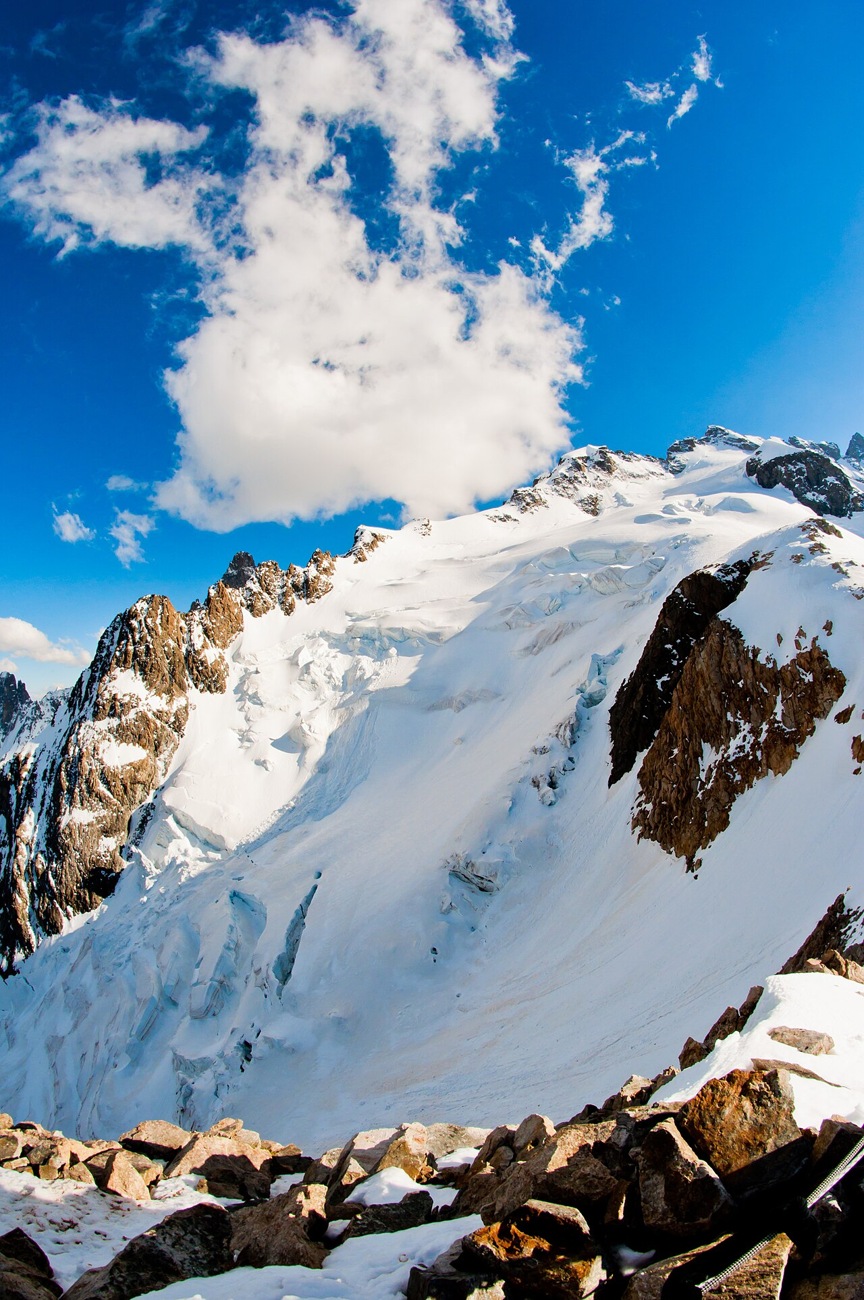
The Eastern Summit of the Meije Ridge
Écrins National Park distinguishes Meije Orientale from the two summits to its west, placing it at 3,891 m as the lowest of the three principal points. W. A. B. Coolidge's 1879 account in the Alpine Journal published a labelled panorama showing the view from the Vallon des Étançons, in which the eastern summit appears as a recognizable feature of the ridge crestline. The 1880 Alpine Journal notes that the east summit ridge abuts the chain of the Bec de l'Homme, a geographic relationship that sets it apart from the central and western portions of the massif.
The Tabuchet Glacier occupies the northern side of this part of the ridge. Views from La Grave to the north and from the Étançons valley to the south present the summit from different angles, and the terrain around the eastern peak differs markedly from the broader faces associated with the Grand Pic. IGN's placement of Pic Oriental confirms the summit's distinct identity within the mapped topography of the Écrins.
First Ascents of the Eastern Peak
The Alpine Journal of 1880 records Henry Duhamel's party as the first to reach Meije Orientale, on 21 August 1878. This ascent followed the earlier first ascent of the Grand Pic in 1877 and was treated by the journal as a separate achievement on a separate summit. Duhamel placed a cairn on a slightly lower south point of the peak during that visit.
A subsequent party recorded in the 1880 Alpine Journal reached the eastern summit on 29 June 1880, approaching via the Glacier du Tabuchet and the Col de l'Homme. From the main crest, the central summit appeared to them, in the journal's account, as a blade leaning toward the Étançons valley. They observed three cairns on the western peak from their position. Snow conditions prevented the 1880 party from safely descending to the south point where Duhamel had placed his cairn.
Refuge de l'Aigle and the High Northern Flank
Refuge de l'Aigle stands on a rocky perch above the Romanche valley alongside the Tabuchet ice, at around 3,450 m. A renewed effort beginning in 1909 led to the assembly of a prefabricated larch cabin on the site in 1910. According to the Angoulême section history, portage from La Grave on human backs accounted for approximately 22 percent of the total construction costs.
The hut was closed and disassembled in 2013, then reopened on 9 August 2014. The operator notes that the frame of the original timber chalet was retained during the reconstruction. This refuge sits on the northern flank of the ridge near the eastern summit and is distinct from the refuge located on the western face of the massif.