
Geological Age and Cone-Building
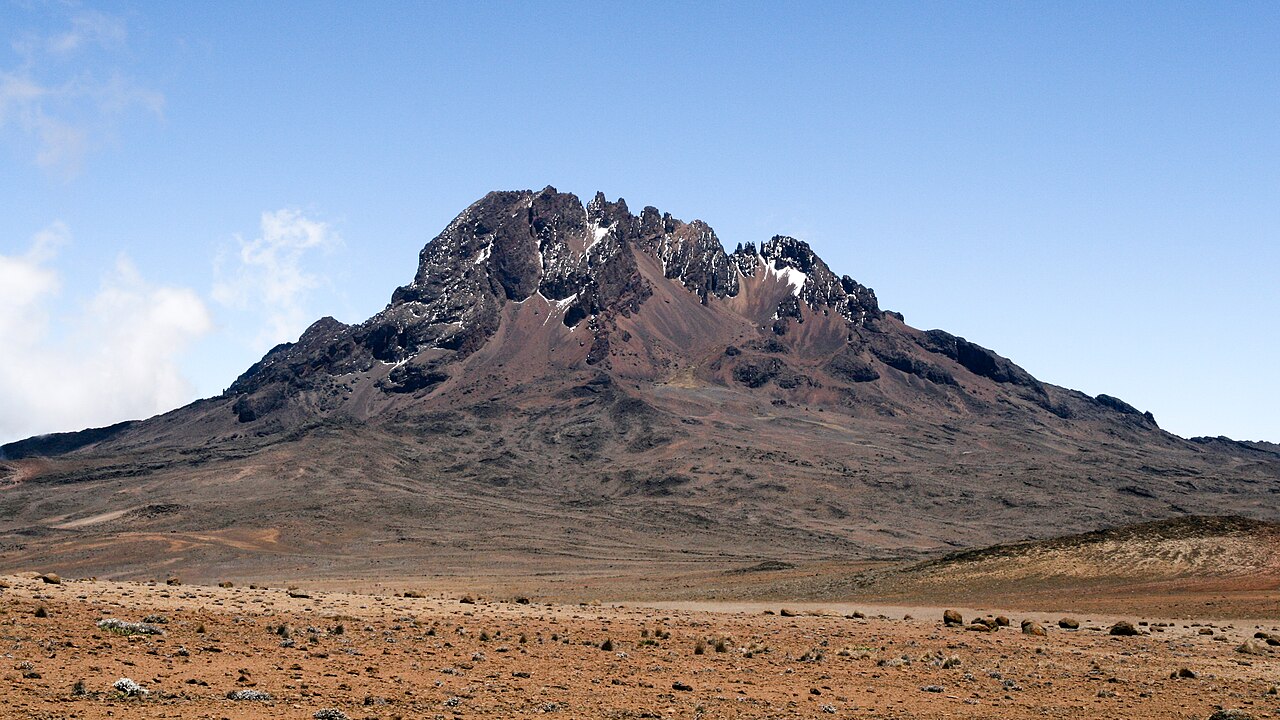
Mawenzi is an eastern volcanic cone on Kilimanjaro, rising to 5,149 metres and separated from Kibo by a broad high saddle. Research using potassium-argon dating, carried out by Nonnotte and colleagues, places the beginning of volcanism across the eastern Kilimanjaro zone at roughly one million years ago. Rocks associated with the later stages of Mawenzi's own cone-building are dated to approximately 492,000 and 448,000 years before the present. These ages describe phases of construction rather than a confirmed last eruption date.
Spires and Glaciation
Tanzania National Parks describes Mawenzi's upper terrain as rugged spires and pinnacles, with traces of glaciation present across the peak. Historical glaciological research by Hastenrath and Greischar established that a small perennial ice patch on Mawenzi disappeared around the 1930s. This finding is specific to Mawenzi and is not an observation about the larger glacier systems on Kibo.
Climbing History
The highest point of Mawenzi is Hans Meyer Peak. Hans Meyer and Ludwig Purtscheller reached a different pinnacle of the mountain during their 1889 Kilimanjaro expedition. The first documented ascent of Hans Meyer Peak was made in 1912 by Fritz Klute and Eduard Oehler. Mawenzi's summit is not a single approachable point but a concentration of rock towers, and the 1912 Klute-Oehler climb stands as the earliest recorded ascent to Mawenzi's true highest point.