
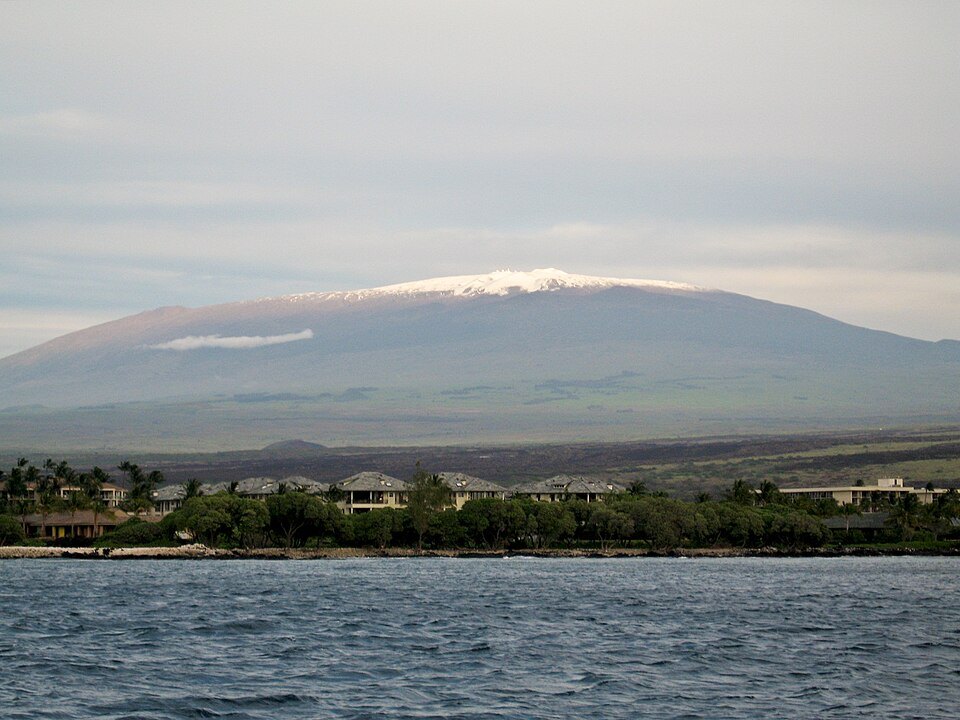
A Volcano Measured from the Seafloor
Mauna Kea is one of five volcanoes that together form the island of Hawaiʻi, the largest and youngest island in the Hawaiian–Emperor seamount chain. Among those five hotspot volcanoes, it ranks as the fourth oldest and fourth most active. Its origins trace to a preshield phase driven by the Hawaiʻi hotspot approximately one million years ago, and the volcano became exceptionally active during its shield stage until around 500,000 years ago. Today it is considered dormant.
What sets Mauna Kea apart from virtually every other mountain on Earth is the scale revealed when prominence is measured from the ocean floor rather than sea level. Its submarine base-to-summit rise of 30,610 feet (9,330 m) is rivaled only by Mount Everest. Even from sea level alone, its topographic prominence of 13,803 feet (4,207.3 m) ranks 15th in the world. The volcano continues to slowly subside and flatten under its own immense weight at a rate of less than 0.01 inches (0.2 mm) per year, and much of its mass lies east of its present summit.
Summit Conditions and Astronomical Significance
The combination of high elevation, an exceptionally dry environment, and stable airflow patterns places Mauna Kea's summit among the premier sites on Earth for astronomical observation. These are the properties that led, following the construction of an access road in 1964, to the development of what became the Maunakea Observatories—a complex of thirteen telescopes funded by eleven countries. Together they constitute the largest astronomical observatory facility of their kind, used for scientific research spanning the full electromagnetic spectrum.
Geography and Neighboring Peaks
Mauna Kea's summit stands 13,803 feet (4,207.3 m) above sea level, placing it approximately 125 feet (38 m) above Mauna Loa, its more massive neighbor on the same island. As the highest point in the state of Hawaii, it also gives the island of Hawaiʻi the second-highest island high point in the world, surpassed only by New Guinea. The volcano's bulk is not symmetrically distributed around its present summit; much of its mass extends to the east, a consequence of the gradual, ongoing deformation caused by its own weight pressing on the Pacific Plate.