
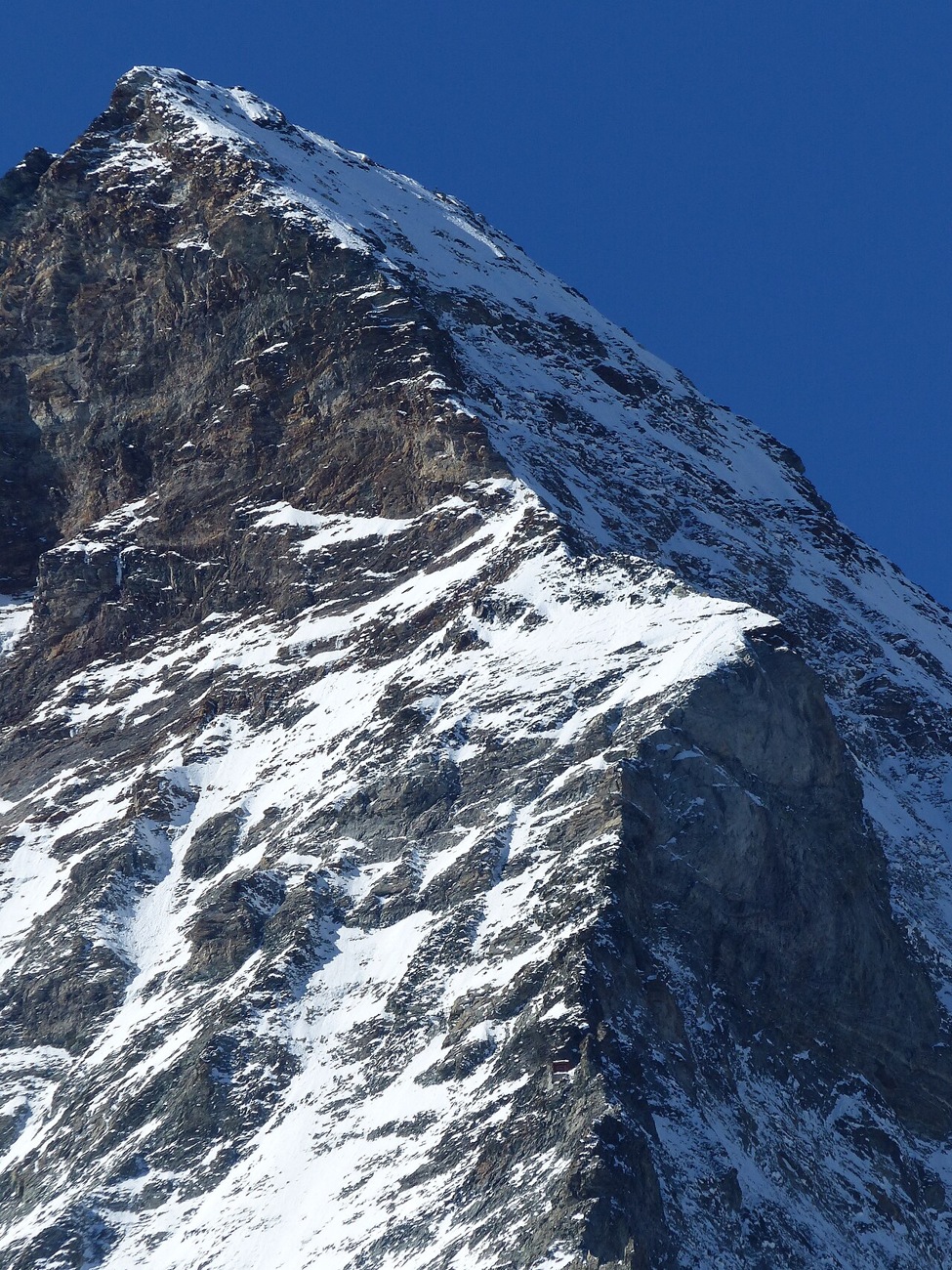
Terrain and the First Ascent of 14 July 1865
On the night before the summit attempt, Edward Whymper's party of seven pitched their tent near the foot of the actual peak. The climbers — Whymper, guide Michel Croz, Charles Hudson, Francis Douglas, Douglas Robert Hadow, and Peter Taugwalder father and son — found the crest less feasible in places on the upper mountain and traversed onto the north-facing slope before regaining the ridge and reaching the summit. Whymper's firsthand account in Scrambles Amongst the Alps records these terrain choices as they unfolded on the day.
The descent brought catastrophe. Croz, Hudson, Hadow, and Douglas fell and died. The event fixed the Hörnligrat in mountaineering memory as the route of the first ascent and as the place where four members of the party were lost on the same July day.
The Solvay Bivouac at 4,003 Metres
The Hörnlihütte at the foot of the ridge opened in 1880, but the demands of rescue on the upper mountain led the Swiss Alpine Club to plan a dedicated emergency shelter far higher. Belgian industrialist Ernest Solvay offered CHF 20,000 toward the project in 1904, and the municipality of Zermatt approved the shelter for emergency use only in 1912. Architect Alphonse de Kalbermatten and foreman Oskar Supersaxo oversaw construction. Materials were cut and prepared in Visp, moved by train and pack mule to the Hörnlihütte, then hauled in six winch stages up the ridge, totalling approximately 8,000 kilograms of supplies.
The shelter was completed on 31 August 1915. The finished room measured roughly five by four metres and contained no table or beds when the work was done. It stands at 4,003 metres, positioned to serve climbers who cannot safely descend or continue in deteriorating conditions on the upper ridge.
Rockfall, Rock Temperature, and Field Research from 2003 Onward
On 15 July 2003 a rockfall released approximately 1,500 cubic metres of material from around 3,500 metres on the ridge. The fracture surface exposed compact ice, and the predominant rock types at the site are gneiss and amphibolite. Eighty-four people were evacuated by helicopter following the event. The rockfall location sits below the Solvay Bivouac farther up the ridge.
Weber and colleagues published a peer-reviewed dataset in Earth System Science Data in 2019 documenting field observations made between 2008 and 2018. Instruments measuring weather, rock temperature, and fracture motion were placed on steep terrain in the area. Compact ice found at fracture surfaces following the 2003 event indicates that ice had occupied some cracks, one observation among the range of measurements the study reported.