
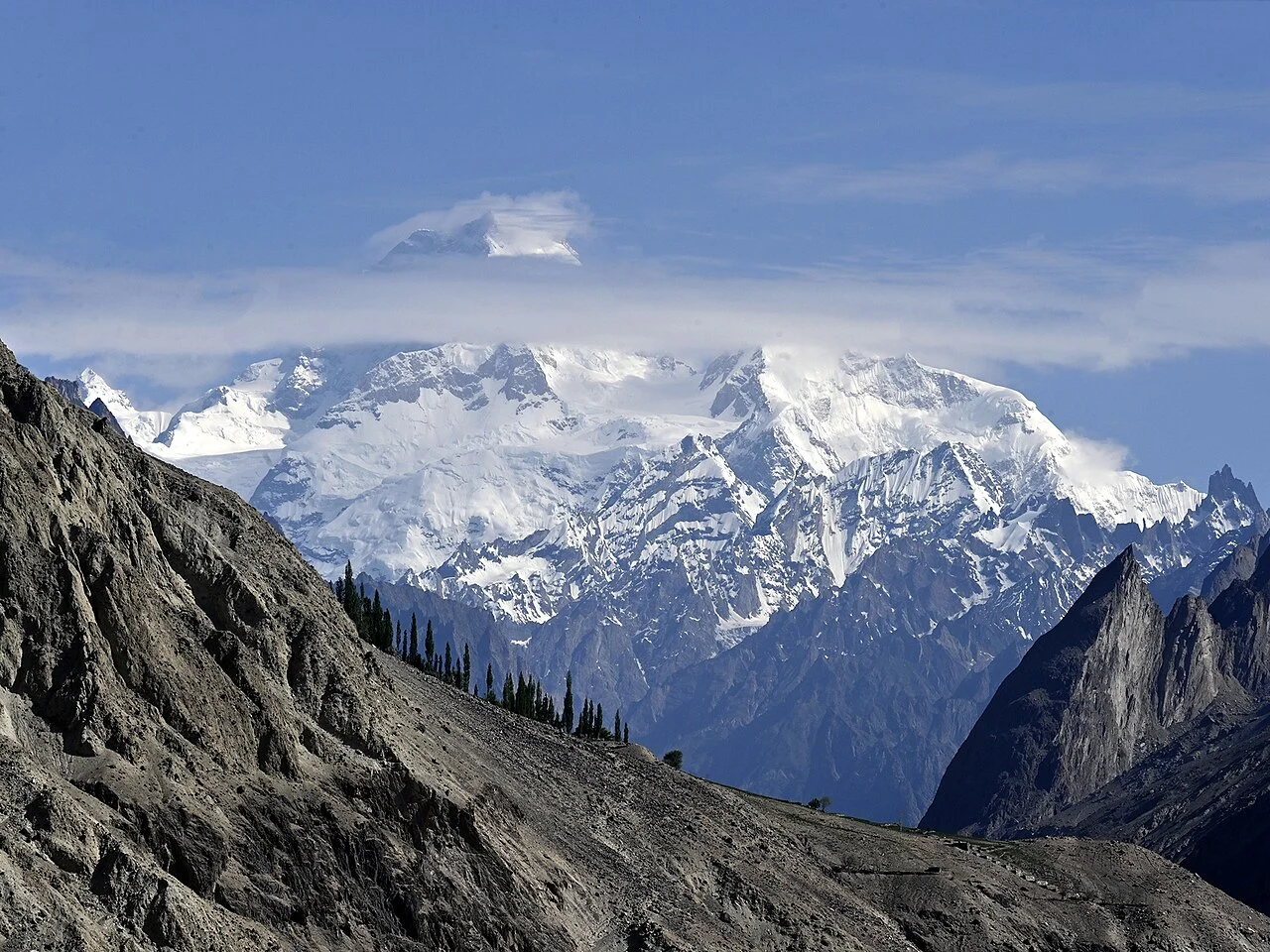
Topography and the K1 Designation
Masherbrum presents two summits: the main northeast point at 7,821 metres and a lower southwest subsidiary. The Pakistan Tourism Guide lists the peak under the K1 survey label. The distinction between the two summits matters for climbers approaching from any direction, as routes that reach the southwest point fall short of the principal top.
The mountain rises above the Hushe Valley on its southern aspect. The Serac Glacier provided the approach corridor for the first ascent, while later expeditions from the northwest worked through the Mandu and Yermanendu glacier basins on the opposite side of the massif.
The 1960 First Ascent
The American–Pakistani expedition of 1960, led by Nicholas Clinch, approached Masherbrum from the south via Hushe and the Serac Glacier. On 6 July, George I. Bell and William Unsoeld became the first climbers to stand on the main northeast summit. Two days later, on 8 July, Clinch himself and Pakistani climber Jawed Akhter completed a second summit push by the same route, adding a second national to the first-ascent record. The expedition also reached the separate Serac Peak on 9 July — a distinct achievement from the Masherbrum ascent that the American Alpine Journal report treats as an independent objective.
Clinch's account in the American Alpine Journal documents a technically demanding climb on a peak that had resisted earlier attempts. The southern line via Serac Glacier remained the reference route for subsequent teams planning approaches from the Hushe side, and the 1960 expedition's logistics — managing altitude, glacier travel, and high-camp placement — established the baseline understanding of the mountain's southern character.
Later Ascents and the Northwest Faces
A Japanese team revisited Masherbrum in 1983, completing a repeat ascent of the south face, as reported in the American Alpine Journal. The northwest aspect attracted attention in 1985, when two separate expeditions reached the summit within a day of each other by distinct glacier approaches. A Japanese party, working via the Yermanendu Glacier, gained the summit on 23 July. The following day, 24 July, Robert Renzler's Austrian party completed their own northwest-face route, approaching through the Mandu Glacier. Renzler's American Alpine Journal account describes these as separate lines rather than the same path, though the reporting does not resolve the precise sequence or rank the two groups relative to each other on the northwest side.
The 1985 ascents on the northwest face approached via the Mandu and Yermanendu glacier basins, each providing a distinct line to the summit.