
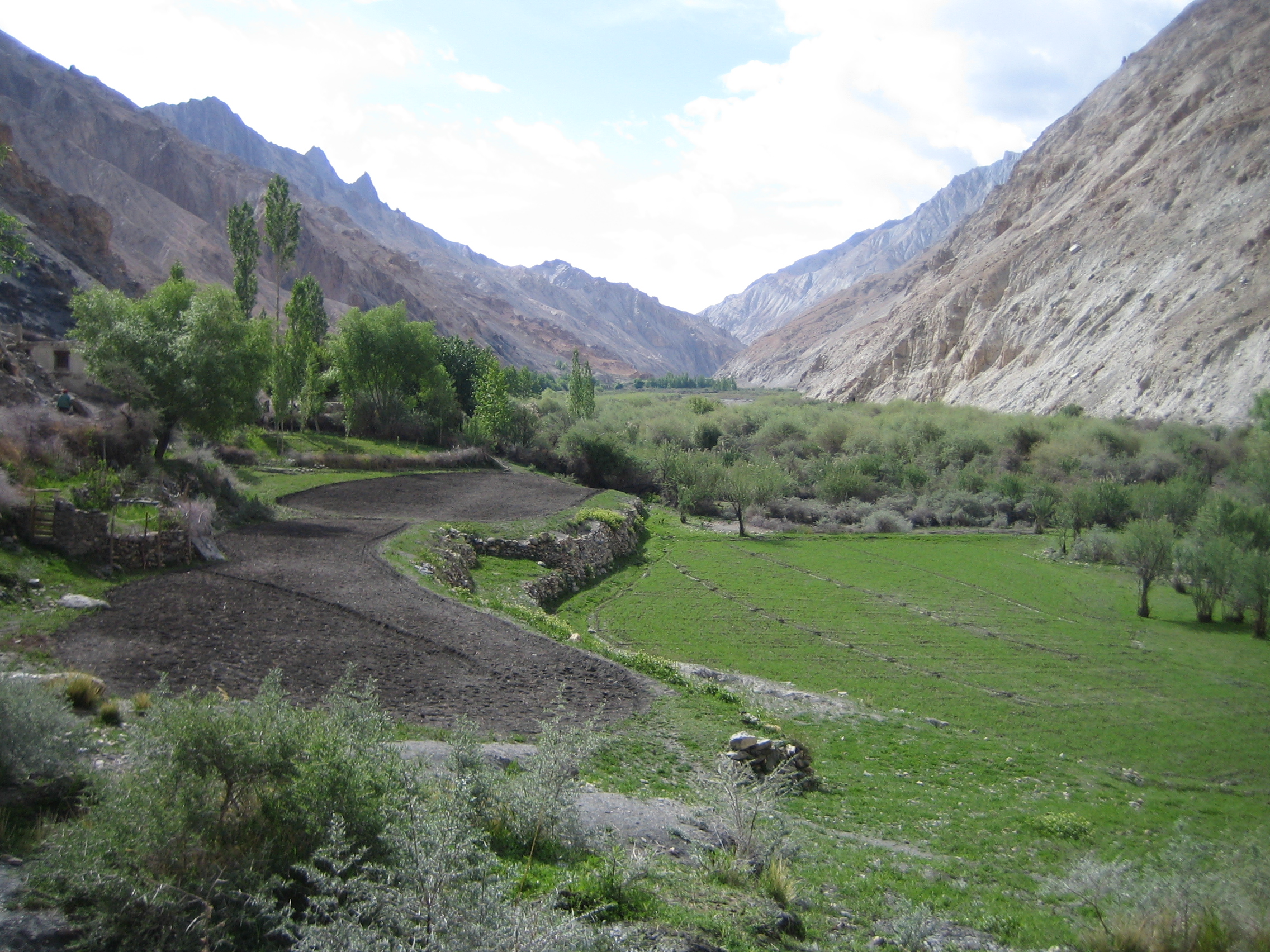
Ice in the Markha Valley
Bodo Damm identified eight relative glacial stages in the Markha Valley and the northern Nimaling mountains, reading abraded rock faces and ledges in the lower and middle valley as evidence of earlier, more extensive ice, and tracing successive margins higher in the drainage through moraines and till. The sequence shows which ice margins came first, with few absolute dates. In the upper valleys around the Kang Yatze massif, Schmidt and Nüsser mapped 121 glaciers and found aggregate glacier area fell from 96.4 to 82.6 square kilometres between 1969 and 2010, a measured decline of 14.3 percent across that study area.
Above Hankar, one of the two upper streams leads toward the pastures of Nyimaling. The other comes from the Langthang Chen valley. Archaeologists documented the remains of a fortified settlement at Hankar in 2011.
Mountain passes and trade
The 2011 archaeological field survey by Devers and Vernier documents five historic entries into the valley. These include Ganda La from the Indus side, the Zanskar confluence near Chilling, and the Jumlam trade branch near the gonpa at Teacha, reached by way of Shakyam Tokpo. On the Jumlam route, traders exchanged salt from lakes in northern Changthang for barley from the Zanskar valleys.
At Dzasa Thang, beside the Markha–Zanskar confluence, the same survey records distinctive overlapping petroglyphs showing people, ibexes, and wild sheep. Differences in surface weathering and the overlap of the carvings show that people added figures in more than one period.
The painted chorten at Markha
The chapel at Skyu, also written Skiu, contains murals that the field account and a publication by Kerin tentatively date to the late twelfth or early thirteenth century. At Markha village, a 2014 study by Vernier and Devers revises the dating of the painted chorten, proposing late fifteenth or early sixteenth century construction and painting, subject to further revision. Within the same structure, a reused carved wooden column is dated on stylistic grounds probably to the eleventh or twelfth century, making it substantially older than the chorten itself. A later set of dedicatory inscriptions names a lama called Drungba Rinpoche.
Below Markha's old palace, the Hemis Labrang served visiting monks affiliated with Hemis Monastery and was subsequently used briefly as a school run by monks, according to the 2011 field report.
Wildlife in winter
In 1981, writer Simon Fraser accompanied wildlife biologist Ben Osborne on a winter wildlife survey that included the Markha Valley, an account Fraser published in the Alpine Journal in 1986. Key Biodiversity Areas inventories for Hemis National Park record that sea-buckthorn (Hippophae rhamnoides) in the Markha and Chang Chu valleys provides winter habitat for birds including the white-winged redstart (Phoenicurus erythrogastrus) and the white-browed tit-warbler (Leptopoecile sophiae).