
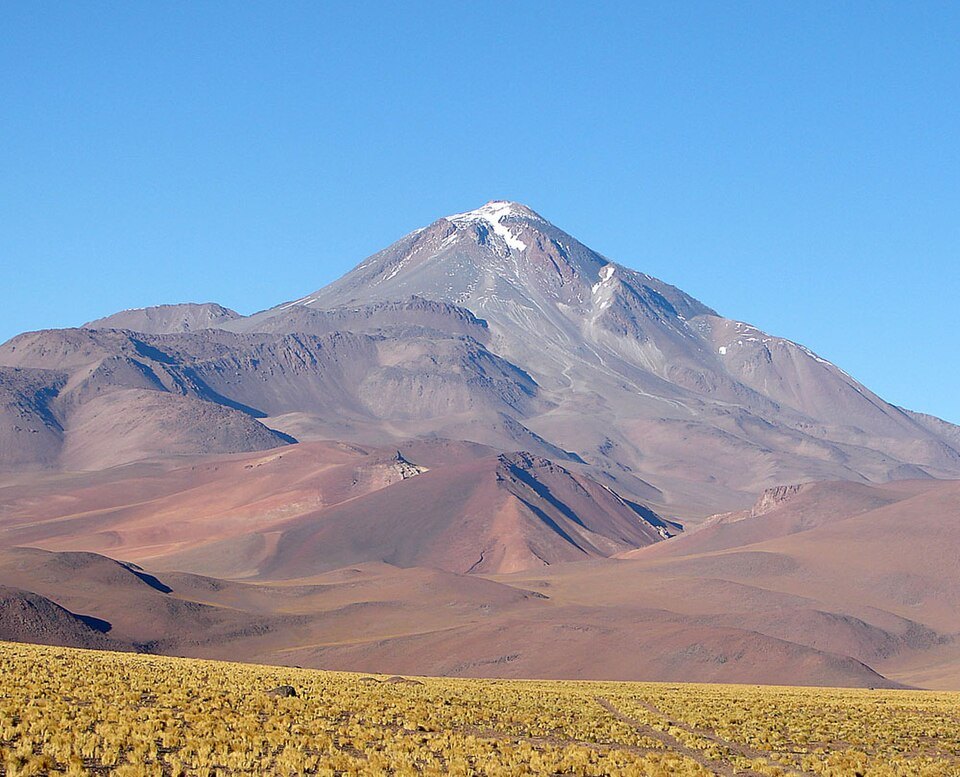
Geography and border position
Llullaillaco stands in the northwestern portion of the Argentine Andes, toward the southern end of the Puna. On the Argentine side it belongs to the Los Andes Department of Salta Province; on the Chilean side, to the Antofagasta Region. The volcano forms part of Llullaillaco National Park. About 30 km northeast of the summit, the Salta–Antofagasta railway crosses the cordillera through the Socompa pass.
Despite its extraordinary height, the sources do not allow certain confirmation of the presence of glaciers: what exists may be only patches of perennial snow and ice. Between 3,700 and 5,000 meters of altitude, the Puna vegetation gives way gradually to rock and ice, in a landscape that forms part of one of the driest and most extreme edges of South America.
Geological formation: two stages of volcanic construction
The volcano formed during the Pleistocene in two distinct phases, known as Llullaillaco I and Llullaillaco II. Around 150,000 years ago the eastern flank of the volcano collapsed, generating a debris avalanche that reached as far as the Cerro Rosado area, some 17 km to the east — one of the largest-scale events documented in the geological history of this Andean segment.
During the more recent stage, prominent lava flows were emplaced over the summit. This history of activity in two major pulses, interrupted by a large-scale sector collapse, illustrates the evolutionary complexity that characterizes stratovolcanoes of the central Andes.
Inca archaeology at the summit
Llullaillaco ranks among the highest-altitude archaeological sites documented in the world. The mountain and its surroundings preserve traces of human occupation that attest to the ritual importance conferred upon it by Andean cultures, and the Qhapaq Ñan road passes nearby as evidence of Inca presence in the region.
In 1999, an archaeological expedition led by Johan Reinhard and Constanza Ceruti found on the summit the mummified remains of three children along with offerings associated with the Inca ceremony of Capacocha. The children and their offerings, preserved at the Museo de Arqueología de Alta Montaña (MAAM) in Salta, constitute one of the most significant archaeological discoveries of recent decades in the Andes. The exceptional state of preservation of the mummies, attributable to the extreme cold and dryness at the summit, has enabled detailed studies of Andean ritual practices.