
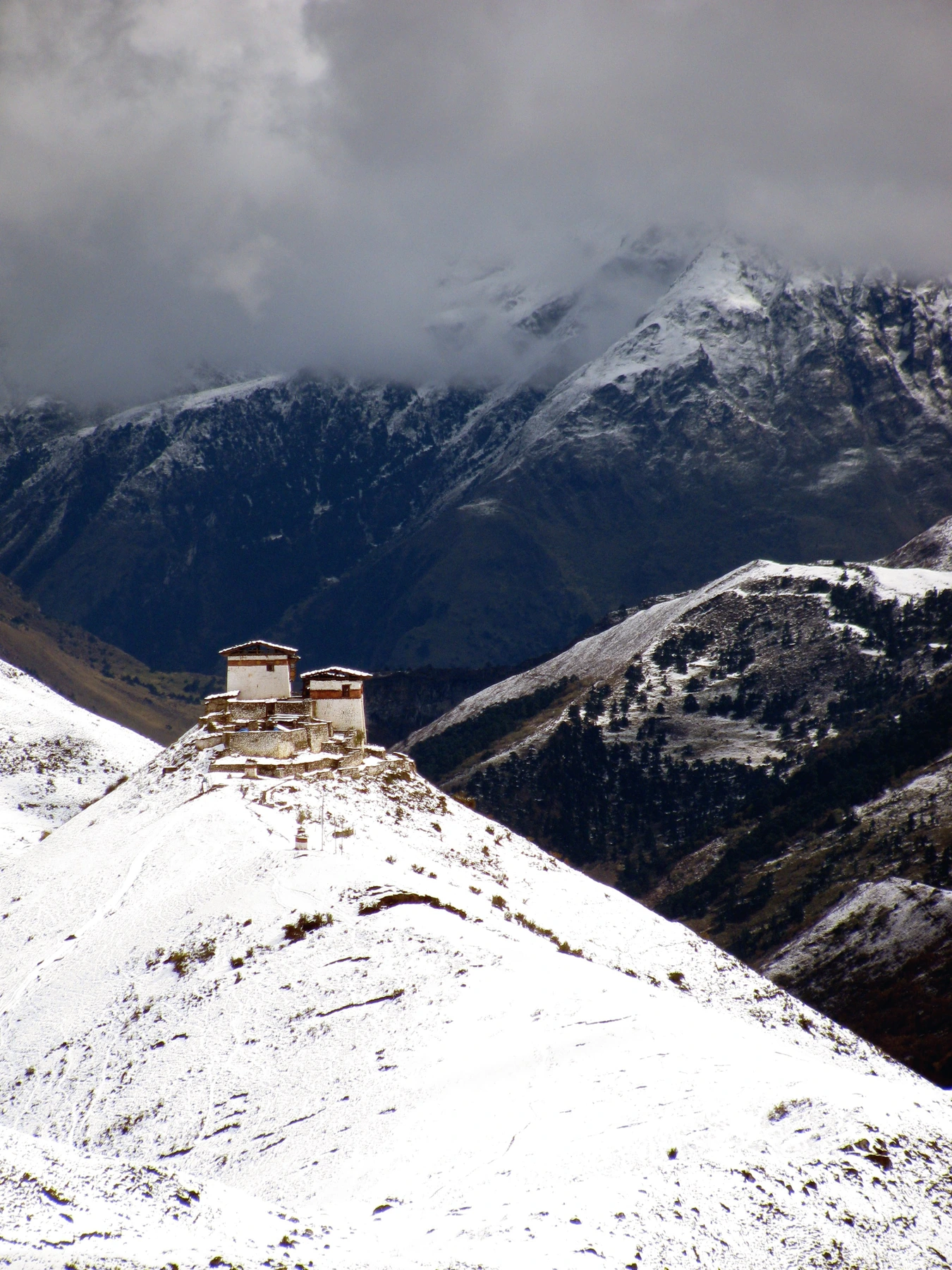
Moraines and the Record of Former Ice
A moraine is the sediment — stones, gravel, and finer debris — deposited by a former glacier as it advanced or retreated. Iwata, Narama, and Karma examined the moraines around Lingshi and distinguished three generations by differences in soil development, vegetation cover, and their positions across the valley. The oldest, the Lingshi Dzong stage, is tentatively assigned to the Last Glacial period. Intermediate deposits, the Jykhuje stages, are associated tentatively with the late Pleistocene and early Holocene. The youngest, the Takaphu stage, is assigned tentatively to the Little Ice Age and late Holocene. These assignments rest on comparative surface evidence, with no direct numeric dates for the locally mapped deposits. Geologist Augusto Gansser explored the area around Lingshi in 1963, and his archive at ETH Zürich registers a field entry for Yale La on 3 April of that year, a specific episode of modern systematic mapping.
Foundation, Earthquake, and Restoration
The National Museum of Bhutan records that Lingzhi Yügyal Dzong was built in 1668 under Minjur Tenpa, the third Druk Desi, to commemorate the 1667 Bhutanese victory over Tibet and consolidate the northern frontier. Defensive walls with loopholes run along the moraine crest. The fortress sustained severe damage in the 1897 earthquake and was rebuilt in the 1950s. A partial renovation was completed in 2005. The September 2011 earthquake caused further structural damage, initiating a programme of restoration funded by India and governed by Bhutan. That programme concluded with a consecration ceremony in October 2024, documented in Bhutan's national mapped heritage records. The dzong serves both religious and administrative functions within Lingzhi Dungkhag, the sub-district administered from Thimphu District.
Passes and Routes Through the Highlands
The Lingzhi Highlands, also written Lingshi, lie within Jigme Dorji National Park in the northern part of Thimphu District. The Himalayan Journal carries a firsthand Snowman Trek account that reaches Lingzhi from Jangothang, with views of Jitchu Drake and Tserim Kang (Tserim Gung in National Museum sources) along the approach. The Bhutan National Land Commission maps a separate route, Barshong–Lingzhi–Laya, which crosses Yaklay La at 4,942 metres. Both routes reach Lingzhi. In Nelyala, at 4,500 metres within Lingzhi Dungkhag, a field observer recorded Chenzig-Tag-Ngu — identified as Miranthes pseudopallida — in flower in August 2024. The terrain around it, shaped by successive glacial episodes and crossed by high passes, sustains plant communities well above the dzong's moraine ridge.