
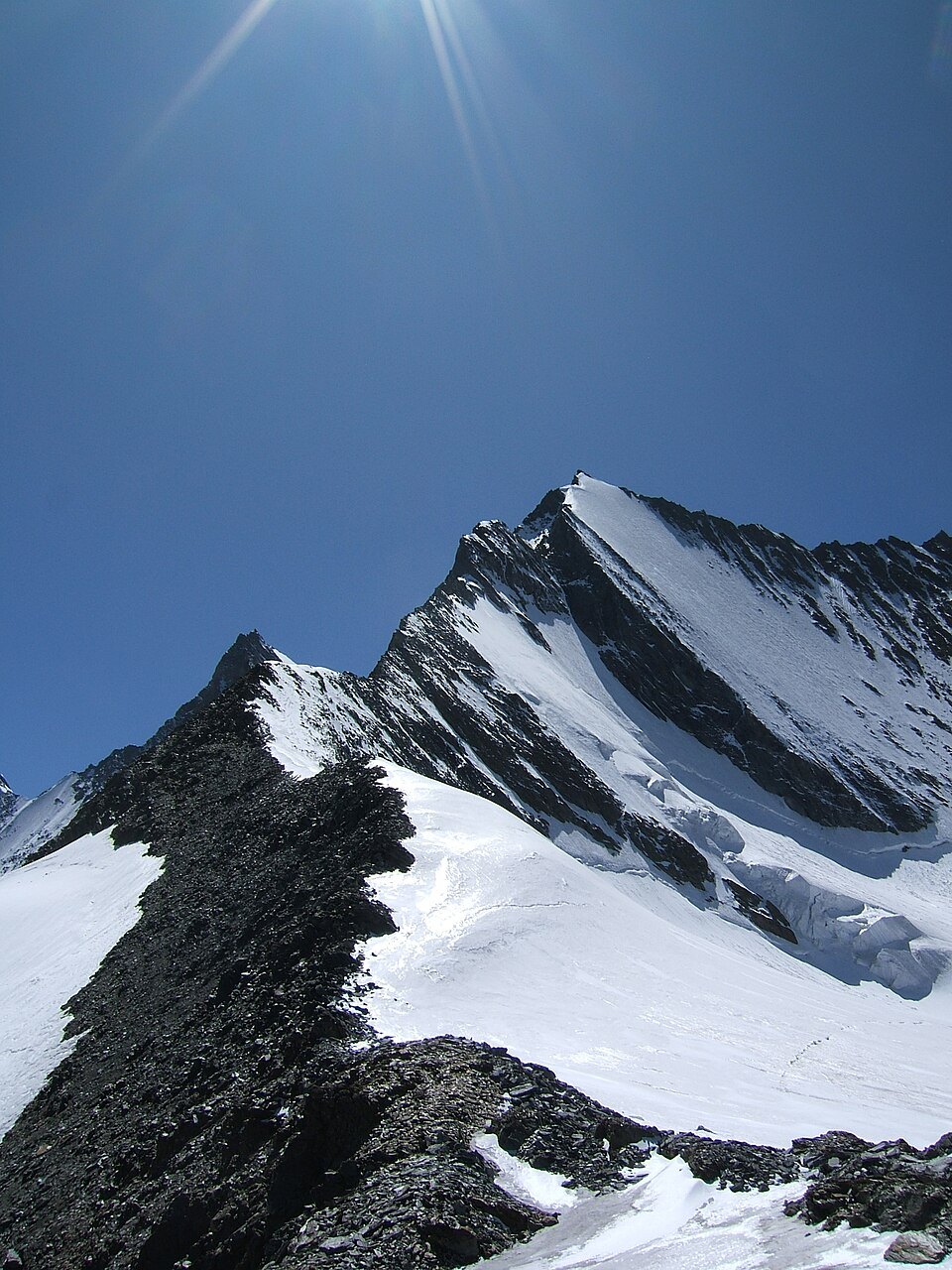
Location and mountain setting
The Lenzspitze belongs to the Mischabel group, the prominent massif in the Valais Alps that unites several of the highest summits of the Swiss Alps. At an elevation of 4,293 m a.s.l. it occupies an independent position within this group. Its flanks drain into the high-alpine terrain shaped by long glacial forms that characterises the Mischabel group.
First ascent and early route history
The first ascent of the Lenzspitze was achieved in 1870 by the Briton Clinton Thomas Dent together with his guides Alexander and Franz Burgener. The route taken at the time led through the north-east face to the Nadeljoch and then along the north-west ridge to the summit – a route that is no longer climbed today. The development of the approach routes in common use today followed in the ensuing decades.
On 3 August 1882 the Briton William Woodman Graham, with guides Theodor Andenmatten and Ambros Supersaxo, made the first ascent of the north-east approach that is today regarded as the standard access from the Mischabelhütte. The route is graded AD, with sections of the fourth grade (IV−), passages of the third grade and otherwise second grade. An easier alternative leads via the south ridge from the Domhütte via the Lenzjoch to the summit, with a maximum difficulty of grade II.
The north-east face – the "Dreieselwand"
The most outstanding alpinist feature of the Lenzspitze is undoubtedly its north-east face: an ice wall with a uniform angle of 50 to 55 degrees, ranking among the steepest faces of this scale in the Valais Alps. On 7 July 1911, Dietrich von Bethmann-Hollweg, with guides Oskar and Othmar Supersaxo, made the first complete ascent of this wall – still in the era of step-cutting, that is, without modern ice tools, which turned the passage into a prolonged and exhausting undertaking.
The toil of that first ascent is reflected in the name the wall has borne ever since: "Dreieselwand". This colloquial designation is not an official map name but a handed-down nickname that arose directly from the hardships of the first ascent. It testifies to the alpine culture of the early twentieth century, in which such nicknames preserved the collective memory of exceptional undertakings.
Guide figures and the local mountain-guiding tradition
The history of the Lenzspitze's development is inseparable from the Valais mountain-guiding tradition. The families Burgener, Andenmatten and Supersaxo appear repeatedly in the first-ascent records – Alexander and Franz Burgener accompanied Clinton Thomas Dent on the first ascent in 1870, Theodor Andenmatten and Ambros Supersaxo led William Woodman Graham on the north-east approach in 1882, and Oskar and Othmar Supersaxo made possible the first ascent of the north-east face in 1911. These names point to a generation of local guides from the Saas valley and the Valais whose intimate knowledge of the terrain made the great era of four-thousander first ascents possible.