
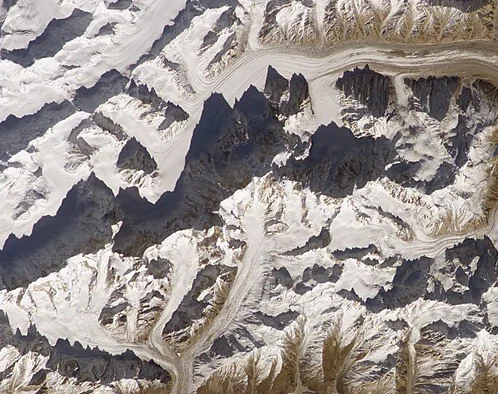
Geography and Naming
Latok I sits within the Panmah Muztagh sub-range of the Karakoram at 7,145 metres. The three Latok peaks share a massif but are distinct summits. The north ridge drops toward the Choktoi Glacier, while the south face is accessible from the Panmah side; each has been the route of a separate significant ascent in the mountain's climbing history.
The north ridge of Latok I rises above the Choktoi Glacier in a long arête. The 1978 attempt on this ridge approached from the Choktoi Glacier side and reached high on the route before the team turned back.
The 1978 North Ridge Attempt
In 1978 an American team comprising Jim Donini, Michael Kennedy, Jeff Lowe and George Lowe committed to the north ridge and pushed high on the route before turning back below the summit. The attempt was extended and technically demanding, and the team's retreat without reaching the top did not diminish the significance of the effort; it established the north ridge as a serious and unresolved problem in high-altitude alpinism. The account published in the American Alpine Journal documented the route and the conditions the team encountered, and the climb entered the record as one of the period's defining near-misses.
First Ascent via the South Face, 1979
The first confirmed ascent of Latok I came the following year, by a Japanese expedition led by Naoki Takada. On 19 July 1979, Tsuneo Shigehiro, Sin'e Matsumi and Yu Watanabe reached the summit via the south face. A second group from the same expedition attained the same summit on 22 July, three days later. The south face route represented a different approach to the mountain's difficulties, and the 1979 ascents established the summit record that would stand for nearly four decades.
The 2018 Second Ascent and the Gukov–Glazunov Attempt
The second ascent of Latok I's main summit did not come until August 2018, when Aleš Česen, Luka Stražar and Tom Livingstone climbed from the Choktoi Glacier by way of a portion of the north ridge, then crossed to a west col before ascending the southern upper slopes to the top. Their route is distinct from a complete traverse of the full north ridge, though it shares the lower north ridge terrain with the 1978 American line. Livingstone's account in the American Alpine Journal describes the route's character and the conditions the team navigated through the approach and upper mountain.
Separately, in July 2018 — shortly before the Česen–Stražar–Livingstone ascent — Alexander Gukov and Sergey Glazunov reported reaching the top of the north ridge at approximately 7,050 metres. That point is below the main summit elevation of 7,145 metres, and their climb does not constitute an ascent of the principal summit. The two 2018 efforts, undertaken independently and by different lines, together brought renewed attention to the mountain after decades in which the original 1978 problem had remained open.