
Landform and Setting
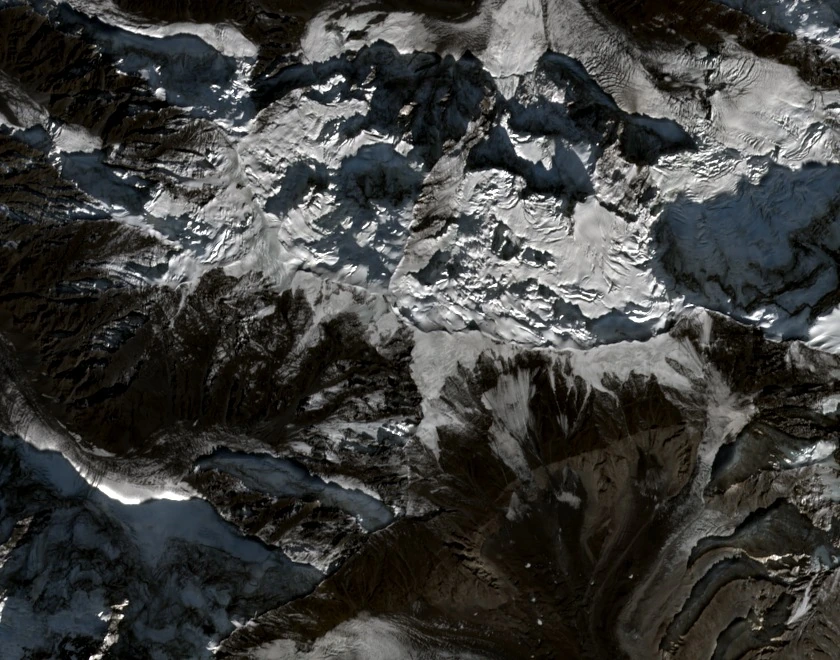
The mountain is a glaciated border summit where ridgelines dividing Afghanistan's Badakhshan from Pakistan's Chitral converge above Rosh Gol, roughly 5 km west of Koh-e-Langar, a separate peak the 2026 AAJ reports at 7,134 m. An October 2025 Sentinel-2 satellite image shows northern slopes heavily mantled in snow and ice alongside the southern ridge, with neighbouring glaciers filling the intervening terrain.
Historical Polish sources from 1968 record the name as Langutar Ba-ari, and the variant Langutai Barfi also appears in the literature. The 2026 American Alpine Journal, reporting on a 2025 expedition, attributes the nickname "bride of the Hindu Kush" to local usage.
First Ascent and Early Routes
The first recorded summit was reached on 27 September 1963 by Polish climbers Maciej Gryczyński and Jerzy Warteresiewicz, approaching from the Afghan side via the west spur to the northwest ridge. The expedition is documented in Andrzej Wilczkowski's report published in the Himalayan Journal and subsequently in Polish Alpine Association summaries. Further ascents followed in 1973, again by the northwest ridge, reached by other approaches to that same feature.
In 2014, New Zealand climbers Pat Deavoll and Chris Todd approached from advance base past a long moraine, crossed the upper Rosh Gol, and climbed part of the south-southeast face before retreating in deep snow a few hundred metres below the summit.
First Pakistani-Flank Ascent, 2021
On 24–25 August 2021, Georgian alpinists Archil Badriashvili, Baqar Gelashvili, and Giorgi Tepnadze completed the first successful ascent from Pakistan, establishing a new line up the south face and east ridge over approximately 1,800 m of climbing. The team crossed a bergschrund and bivouacked at around 6,400 m before reaching the summit, then descended by the same line.
On the same expedition the team made the first ascent of Saraghrar Northwest, which received the 2022 Piolets d'Or.
2025 Return and New Southeast Route
Gelashvili and Tepnadze climbed the southeast face and south ridge in August 2025, gaining approximately 2,000 metres of elevation on the way up. They descended along the east ridge and south flank. They reported exposed rock where the 2014 team had found more snow and ice.