
Sedimentary Record and Active Faulting
Middle Jurassic Kashafrud sandstones and mudstones, studied at outcrops in northeastern Iran, preserve evidence of deep-water sediment fans, marine trace fossils, and sparse ammonites from a sea linked to the Neo-Tethys ocean. Early Cretaceous Tirgan limestone at the Gelian section in northern Iran records a distinct, younger episode of shallow marine carbonate deposition, with microfossils including calcareous algae. Neogene continental collision later folded and deformed both sequences into the mountains visible today.
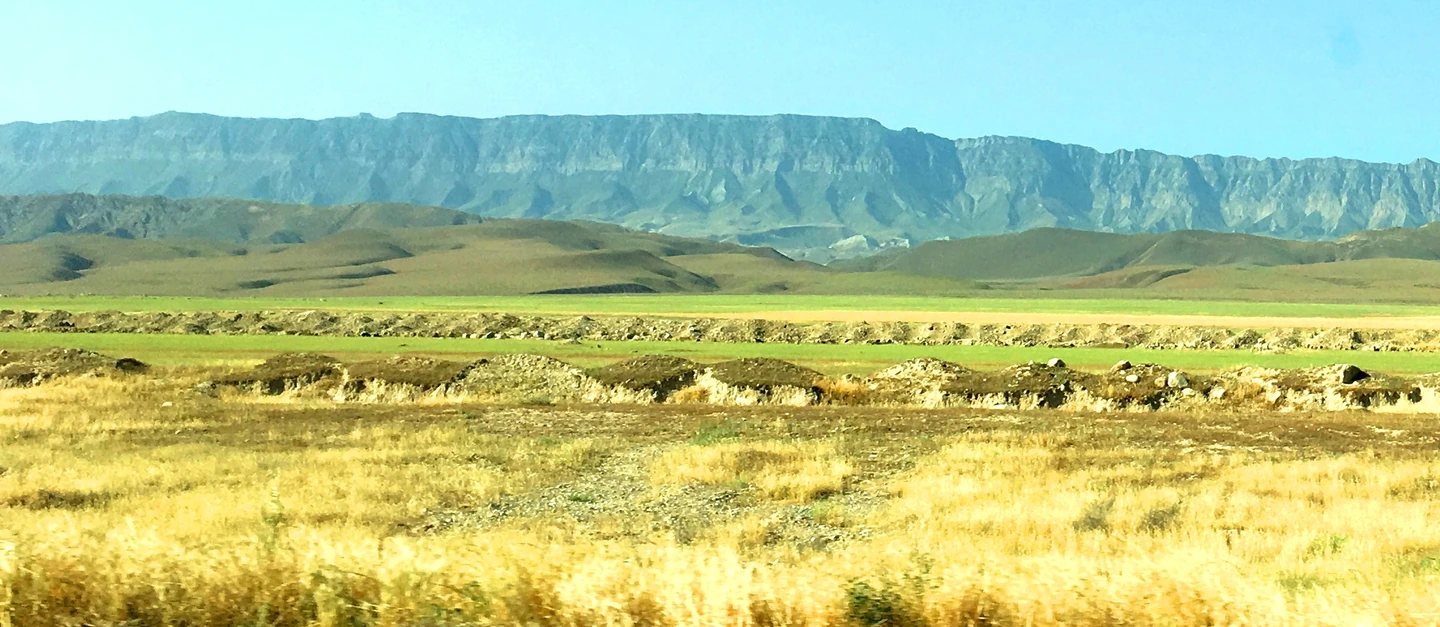
The Main Köpetdag Fault runs along the northern range front and is classified as predominantly right-lateral. A 2022 study using Sentinel-1 radar satellite imagery modeled a horizontal slip rate of 9 ± 2 mm per year across the fault zone in the study segment, reflecting the ongoing tectonic motion that continues to shape the steep northern escarpment.
The 1948 Aşgabat Earthquake
The earthquake devastated Aşgabat during the night of 5 to 6 October 1948. A 2024 reanalysis by Marshall and colleagues used historical seismograms and terrain evidence to revisit the approximately magnitude 7.3 event, concluding that it involved predominant sideways fault movement across more than one local fault.
A museum department head reported that the 2023 Sacred Memory exhibition, held on 6 October Remembrance Day, displayed documentary photographs of the earthquake drawn from the State Museum of the State Cultural Centre archive.
Parthian Ruins at the Range Foot
At the foot of the Köpetdag, the archaeological mounds of Old Nisa and New Nisa preserve an early Parthian political and trading centre. The Parthian Empire was a major regional power from approximately the mid-third century BCE into the early third century CE, and UNESCO inscribed the site in 2007.
Biosphere Reserve and Biodiversity
The Iranian Kopet Dag Biosphere Reserve, entered in UNESCO's Man and the Biosphere Programme in 2018, covers 34,484 hectares in a section of the range near the frontier. It contains mostly forest and woodland, local communities practice agriculture and livestock keeping, and the reserve falls within the Irano-Anatolian biodiversity hotspot.