
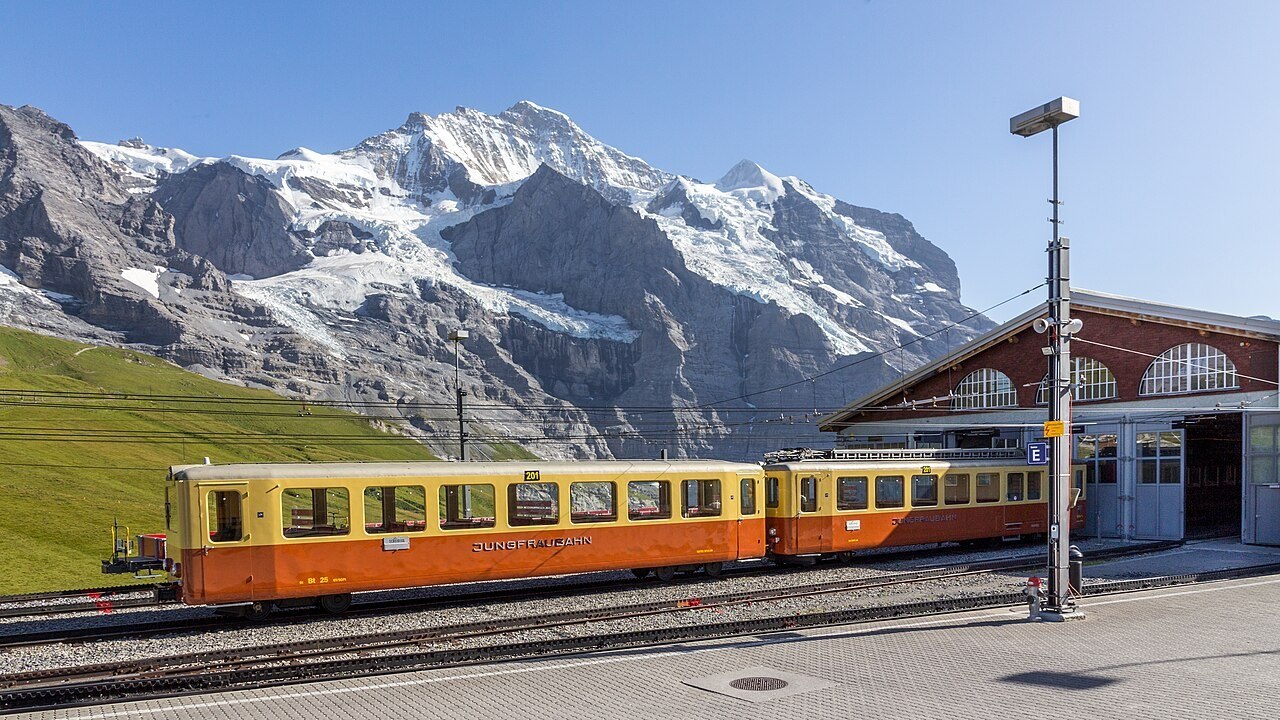
A Saddle With Two Faces
The pass separates the Grindelwald valley to the northeast from the Wengen descent toward the Lütschental. Its broad, exposed saddle at about 2,060 metres channels weather from either direction — a geography that made it a natural meeting point for transport routes crossing between the two valleys.
The Wengernalp Railway and the Origin of a Junction
The Wengernalp rack railway reached Kleine Scheidegg in 1893, connecting the pass to both flanking valleys. Adolf Guyer-Zeller chose the col as the departure point for a railway climbing into the mountains beyond; he applied for a concession in 1893, and construction of the Jungfrau Railway began in 1896.
Into the Mountain: The Jungfrau Railway
The first section of the Jungfrau Railway, running in the open air to Eigergletscher station, entered service in 1898. The line then continued underground, boring through the Eiger and the Mönch. It reached Jungfraujoch — the saddle between Jungfrau and Mönch at 3,454 metres — in 1912, terminating at the col rather than any summit.