
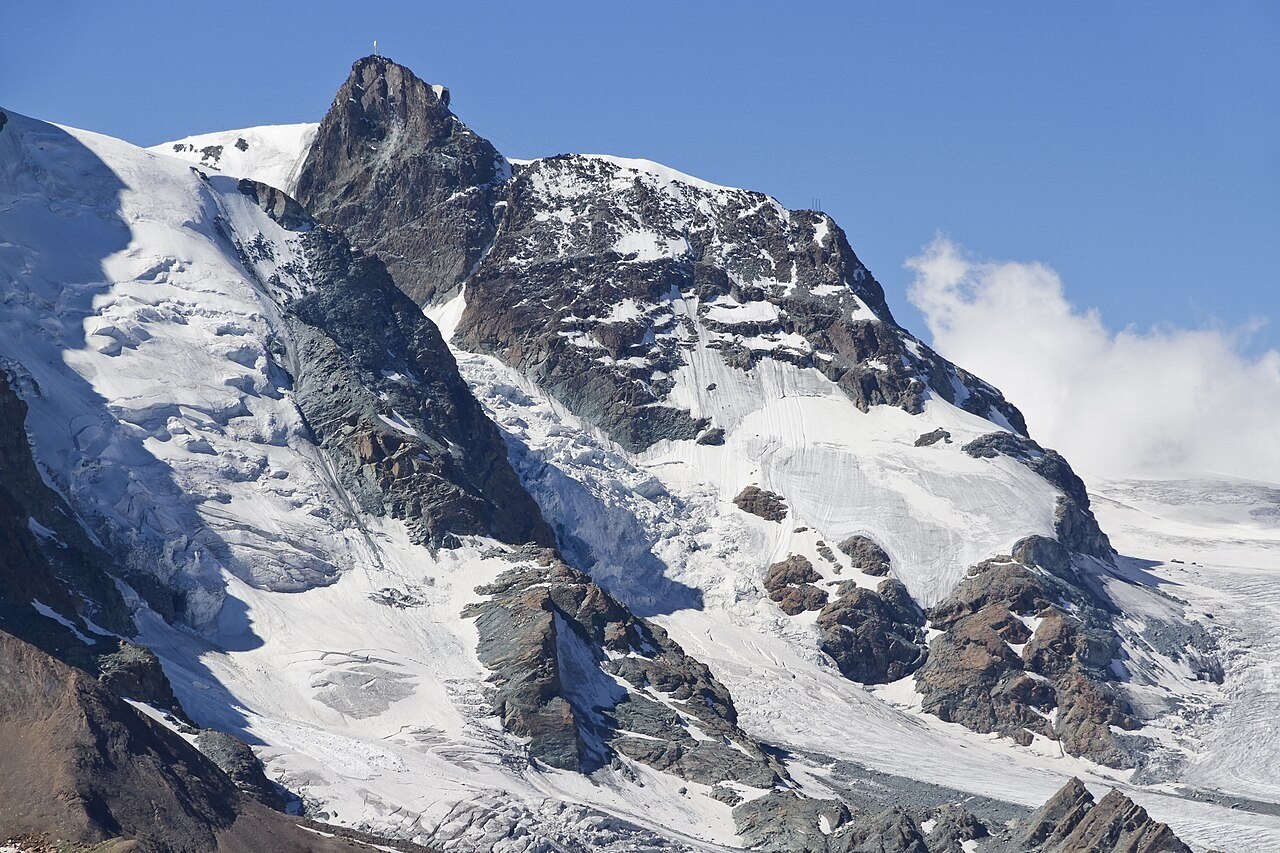
The 1979 Cable Car and the Summit Station
The cable car system connecting the Klein Matterhorn to the Trockener Steg was completed in 1979, after approximately three years of construction. That project established what was at the time a significant engineering milestone in high-altitude cableway development. It is worth noting a distinction the operator's own technical inventory makes precise: the Trockener Steg station sits at 3,820 metres, while the summit itself reaches 3,883 metres — the two points are related by the infrastructure but are not identical, and the distinction matters when evaluating claims about altitude records tied to the 1979 construction.
Position, Elevation, and the Glacier Terrain
The summit's elevation places it well above the permanent snowline in the Valais, and the glacier terrain that extends south from Zermatt surrounds it on multiple sides. This high glacial setting, combined with the summit's proximity to the Swiss-Italian border, gave the 1979 cable car system both its technical challenge and its geographic logic. The surrounding cirques and icefield approaches distinguish Klein Matterhorn from the rockier, more sharply defined peaks visible further north along the Zermatt horizon.
The 2023 Alpine Crossing and a New Border Connection
In June 2023, the opening of a cableway connection toward Testa Grigia on the Italian side completed what the operator calls the Alpine Crossing, extending the high-altitude link across the border. This connection introduced a new function for Klein Matterhorn's summit position: rather than serving primarily as a terminus, it became an intermediate point in a cross-border cableway corridor. The 2023 opening represents a distinct phase in the summit's infrastructure history, adding a lateral dimension to a system that had previously been organised around vertical access from the Zermatt valley below.