
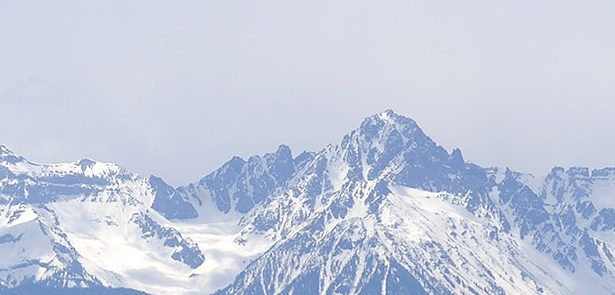
Position and Measure
LiDAR places the summit at 4,176.3 m (13,701.6 ft). The public USGS 1 m elevation grid yields essentially the same height at that coordinate. The Denver Public Library place-name index records a historic value of 13,694 ft. The 1933 American Alpine Journal cited 13,650 ft. Each figure belongs to its own era. Lavender Col lies to the west-northwest at approximately 4,109 m, placing the peak roughly 67 m above its key saddle. Dike Col to the east separates Kismet from Cirque Mountain. Ouray County mapping labels all three summits distinctly.
Geology
The Mount Sneffels–Stony Mountain stock crystallized underground near the edge of the broad Silverton volcanic depression during late phases of the region's volcanic activity, with radial dikes extending outward from the mass. Federal surveys of nearby Yankee Boy Basin document compositions ranging from gabbro to granodiorite within the intrusive body. USGS descriptions record glacial and landslide deposits in the north-facing Dallas Creek drainages and volcanic and intrusive rocks exposed on the upper slopes, with evidence of past glacial action across the surrounding basins and ridgelines.
The 1932 Climbing Party
On 3 July 1932, Gordon Williams, T. Melvin Griffiths, and Dwight G. Lavender scouted from Blaine Basin on the range's north side. On 4 July they returned, reached Kismet via Dike Col, traversed ribs along the south side of the east ridge, and gained the final pinnacle from the southeast. No cairn was found at the summit. A wooden stake lay roughly 200 ft below the top. Lavender and Griffiths published their account in the 1933 American Alpine Journal in a paper titled 'Climbing in the Mount Sneffels Region, Colorado,' which calls the peak Aiguille Kismet. They considered it a possible first ascent while leaving the question open. On 6 July the party made a separate ascent of the north face of Mount Sneffels.