
Building the Smallholder Tea Landscape
Tea cultivation arrived in Kirinyaga through an extension of the smallholder program already operating in neighboring Mathira, Nyeri. Early production from initial sites in the area was processed at Ragati, before Kangaita became a distinct node in the network. An irrigated channel served the Kangaita nursery from the beginning of 1964, as reported in a 1967 Finance and Development account. The nursery was one of two central facilities established at approximately 500 acres each — a figure describing the initial nursery site scale, not the county's total area under tea.
Trial production at the Kangaita factory began in early November 1965. The World Bank archives record the formal operating date as 5 December 1965. World Bank field reviews from the same period document nursery improvements at Kangaita, describing the inspection, seed and propagation work, purchasing arrangements, and rapid leaf transport that connected individual farms to the factory.
Forest Boundary and Water Disputes
In his 1991 study, Alfonso Peter Castro drew on field interviews and departmental archives to document a sequence of proposals to convert forest strips for landless tea growers. A 1967 Kirinyaga County Council proposal to open a forest strip was withdrawn in 1968 after councillors raised concern about river flows. A renewed 1969 request was turned down by the central government on water-supply protection grounds.
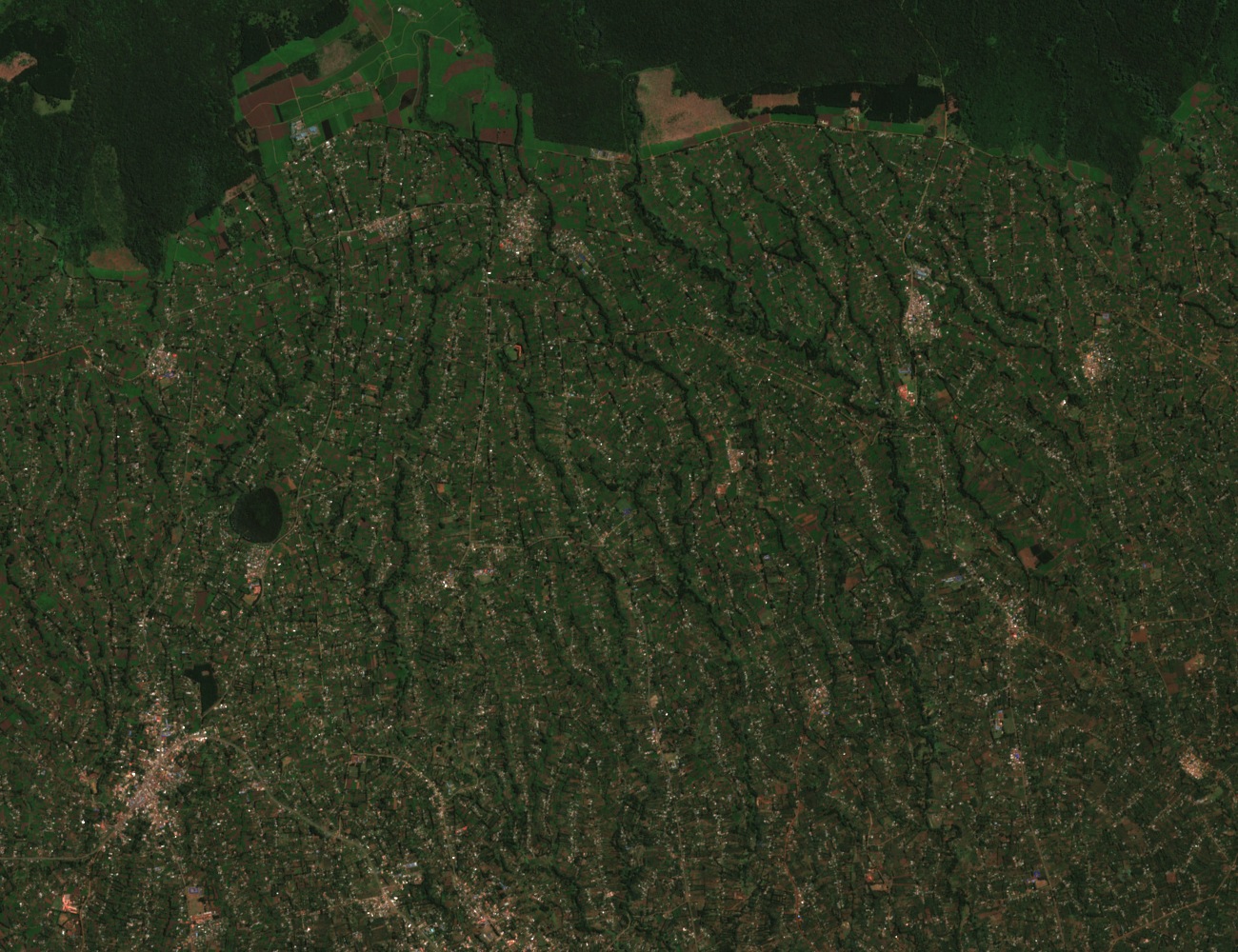
The Kirinyaga County Spatial Plan for 2021 to 2031 delineates the tea zone and conservation forest as separate units on Map 46 Kirinyaga Central. The satellite image acquired by Copernicus Sentinel-2A on 12 August 2026 shows forest occupying the upper part of the image, with wooded gullies and patchwork farmland descending to the south.
Wood Use at the Factories
Drying processed tea consumed substantial wood at Kangaita and at the separate Thumaita factory, which opened in 1975. By the early 1980s both facilities were drawing on eucalyptus supplied by plantations near the forest edge. An official speaking in 1983 estimated annual wood use at the Kangaita factory at 12,000 stacked cubic metres — a KTDA official estimate for that period, not a measured figure for a full calendar year.
Elevation and Tea Chemistry Research
In June 1991, field trial researchers planted twenty tea genotypes at Kangaita and at Timbilil simultaneously. A parallel planting at Kipkebe followed in June 1997. The matched 1991 plantings were designed to allow researchers to separate the influence of site from the influence of genotype when assessing tea chemistry and plain tea quality. Kangaita's field elevation was recorded at 2100 m in that trial. A 2022 tea field study indexed in the Kenya National Research Fund repository measured seasonal temperatures and rainfall at Kangaita and found different climatic conditions between seasons and across the trial sites.