
Glaciers and the Two Valleys
When Narama and Okuno mapped moraines in the area in 1999, they identified two overlapping ridges of glacial debris in front of the Asan-Usin Glacier in the Kara-Su branch. The younger ridge had buried juniper trunks. Radiocarbon dating of the outer rings of one trunk gave a calibrated range of 1645–1665 CE, evidence for the glacier’s local maximum during the Little Ice Age.
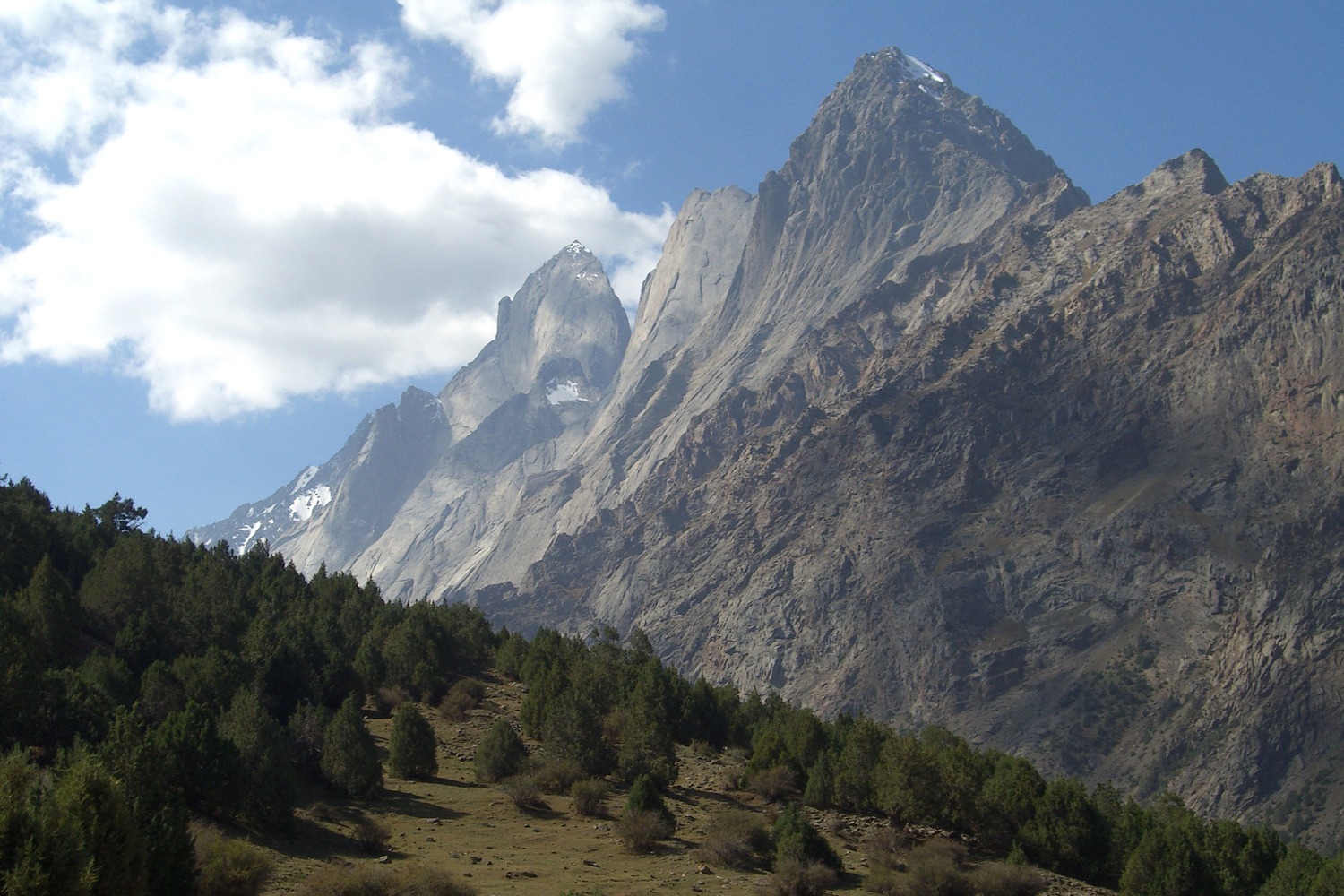
The 4,230-metre Asan tower rises above the Kara-Su branch. The adjoining Ak-Su valley has separate walls, including the Russian Tower, also known as Peak Slesov. The 2007 photograph shows granite walls rising above the grassy valley floor.
The Granite Towers
Climbers have likened these sheer walls and pointed granite towers to the mountains of Patagonia. The British Mountaineering Council expedition report records the nickname Asian Patagonia for this part of the Pamir-Alay.
Asan and the Russian Tower
Mark Bebie and Tom Hargis record climbers from Dnepropetrovsk, Odessa and Rostov making routes on Asan’s west face for the Soviet national championship in 1986. A 1998 American Alpine Journal account by Doug Byerly describes how he and Jimmy Surette climbed a British route on that face in one day. On the same expedition they climbed Perestroika Crack on the Russian Tower in the Ak-Su valley.
In 2009, Nina Caprez, David Lama, Giovanni Quirici and Stephan Siegrist climbed the existing Timofeev Route on Asan’s northwest face without using equipment for upward progress, establishing its first free ascent.