
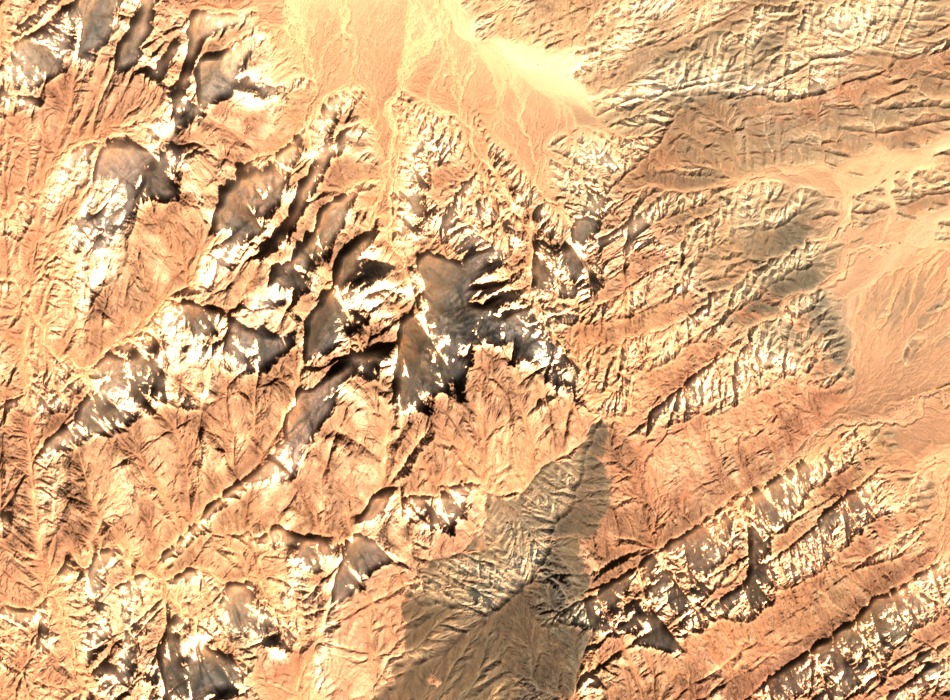
Pink and Red Granite of Late Precambrian Age
The Gattar pluton consists of coarse-grained pink and red granite emplaced during the late Precambrian consolidation of the Arabian-Nubian Shield. Published reports from the 1930s recorded the distinctive feldspar colouration and grain texture, and subsequent Ain Shams University field surveys documented the internal structure of the pluton, including bedding attitudes, joint sets, and fault orientations across the massif.
Molybdenite-Bearing Quartz Veins
Mineralised quartz veins cross-cut the granite and carry vein-hosted molybdenite alongside associated sulphide and oxide phases. Geochemical work published in Ore Geology Reviews characterised the vein assemblages in detail, tracing the distribution of molybdenite and its mineral associations through field sampling and laboratory analysis of material collected directly from the pluton.
Faults, Fractures, and Secondary Uranium Minerals
IAEA field records of the Gattar granite document fracture-controlled zones where secondary uranium minerals, including uranophane, have been observed in mineralised areas. The American Journal of Science and IAEA studies mapped fault systems that localise this secondary mineralisation, attributing its occurrence to hydrothermal fluid migration along structurally controlled pathways within the granite.