
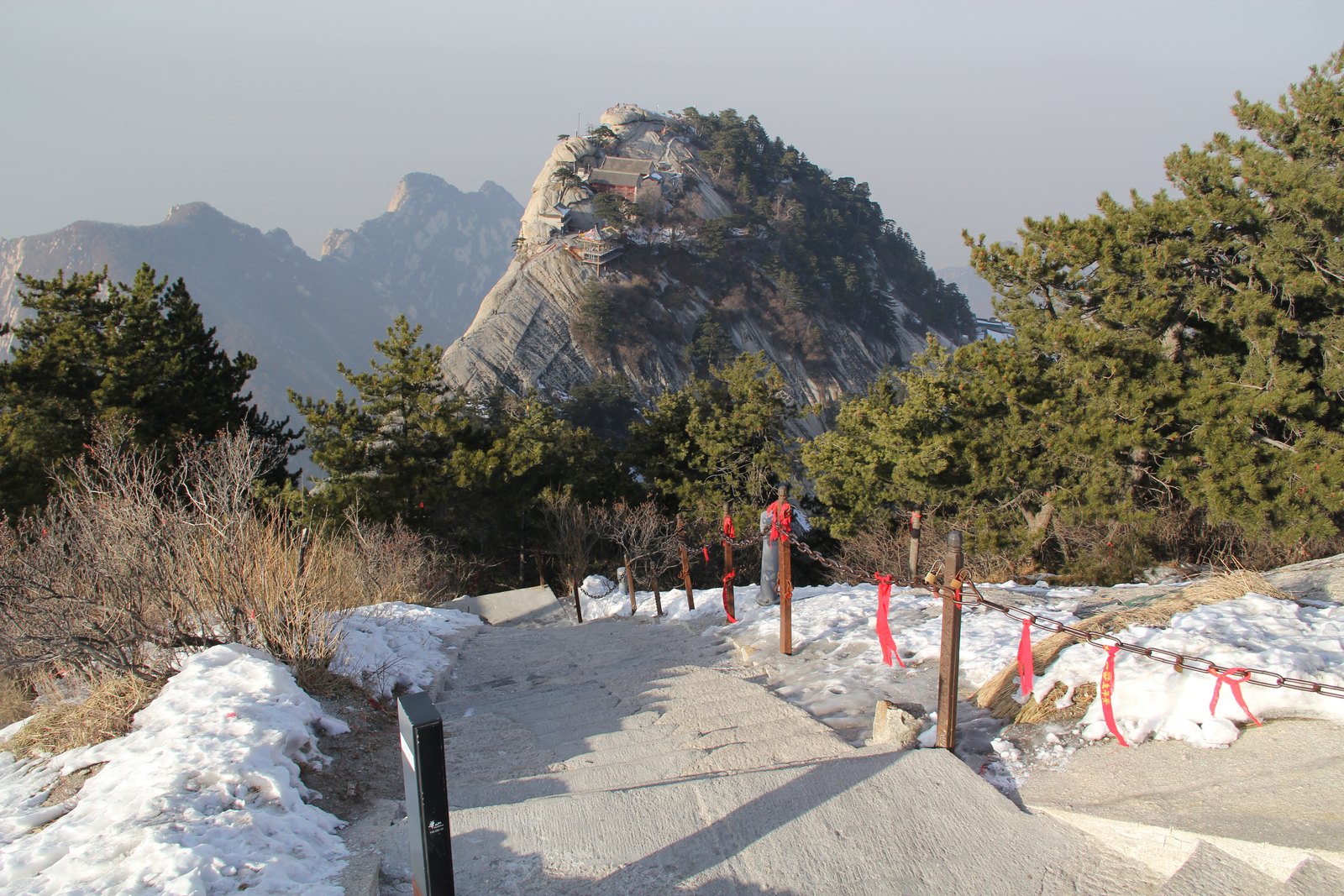
Topography and Peak Configuration
The mountain is composed of granite, with peaks, ridges, and gorges of exceptional definition. Its most striking structural feature is the arrangement of multiple distinct summits connected by precipitous ridgelines, with sheer faces and deep ravines in alternation — a geologically coherent granite landform system of remarkable completeness. It is precisely this near-vertical rock and the compact grouping of peaks that have earned Mount Hua its reputation among China's famous mountains as the most perilous.
South Peak is the highest of Mount Hua's summits. The 2007 announcement by the National Bureau of Surveying and Mapping and the Ministry of Construction gives its elevation as 2,154.9 metres, the officially surveyed and recognised figure. South Peak also bears the alternate name Luoyan Peak (Falling Geese Peak), a name that appears in official sources and is a documented alternate toponym within Mount Hua's place-name system.
Status as Xiyue and Ritual Tradition
Mount Hua is classified in traditional Chinese ritual as the Western Sacred Mountain (Xiyue) of the Five Peaks — a system incorporating five geographically directional mountains into the state sacrificial and symbolic order. The UNESCO World Heritage tentative list entry for Mount Hua explicitly identifies the role of the Five Peaks in traditional ritual and Taoist geography, an observation that underscores Mount Hua's historical significance as a node in devotional and cultural geography. It should be noted that tentative list inscription and formal inscription on the World Heritage List are distinct processes; Mount Hua is currently at the tentative list stage.
Alternate Names and Naming Traditions
Mount Hua carries several names in historical literature and local tradition. "Xiyue" (Western Sacred Mountain) is a directional designation within the Five Peaks system, emphasising its position in the ritual geographic order. "Luoyan Peak" refers specifically to South Peak and is a summit-level toponym documented in official sources. Both names have textual foundations and circulate alongside the primary name "Huashan," together forming a multi-layered naming tradition for this mountain.
Historical Ascent Routes
The steep terrain of Mount Hua has historically imposed severe constraints on climbing routes. The sheer granite faces and the orientation of the ridgelines have meant that traditional approaches generally follow ridges and rock fissures, producing a route pattern that closely conforms to the mountain's physical structure. The ridge paths linking the main summits string together the principal high points in a network that is inseparable from the physical structure of the granite massif and that forms the geographic foundation sustaining Mount Hua's climbing tradition to the present day.