
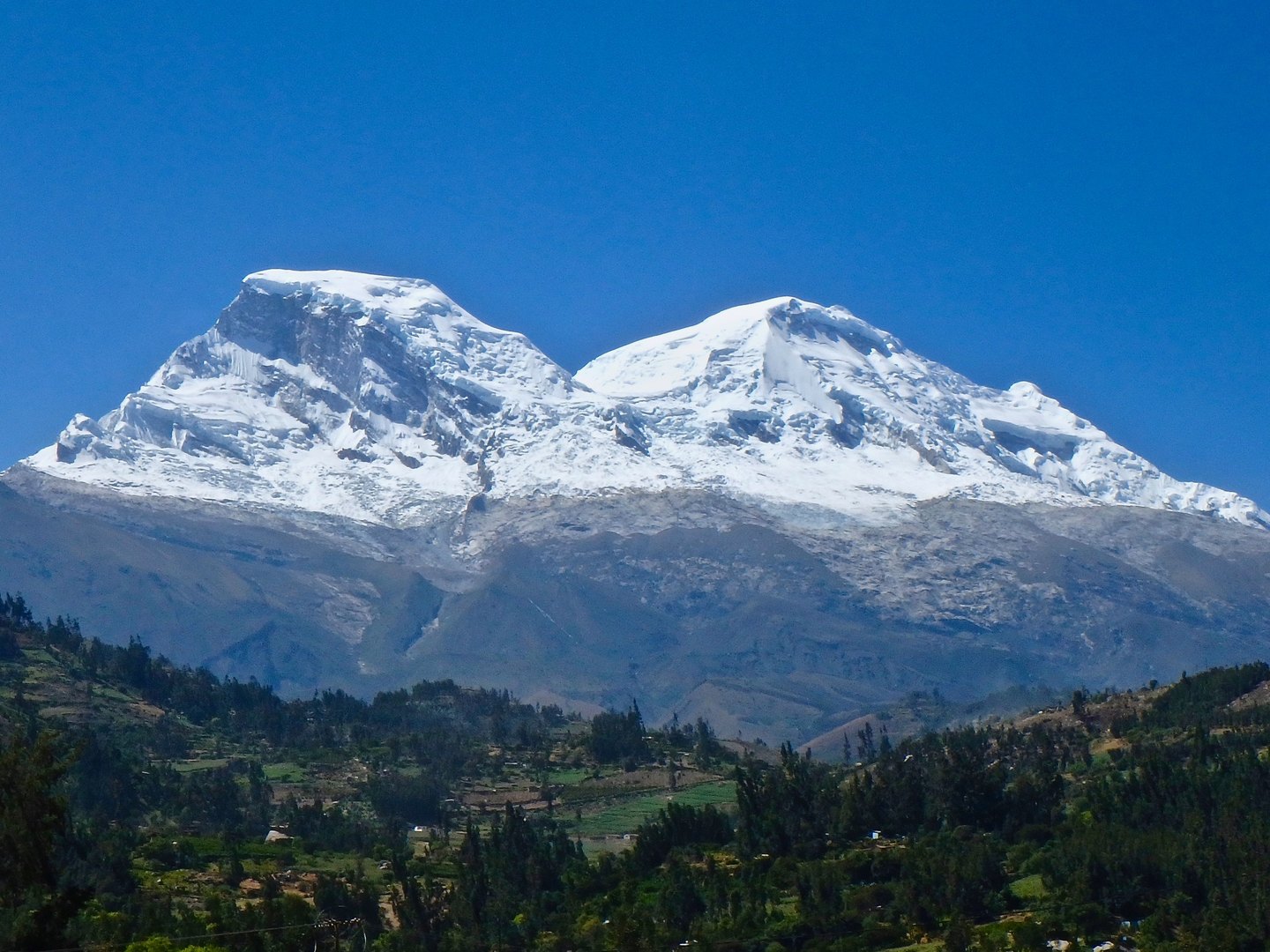
The Cordillera Blanca and the park landscape
The Ministerio de Cultura del Perú describes the Huascarán area as a collection of snow-capped peaks exceeding 6,000 meters in elevation, accompanied by lakes, ravines, and active glacial erosion processes. This description situates Huascarán not as an isolated peak but as the governing element of a mountain system of great topographic complexity. The Cordillera Blanca, the range to which it belongs, is one of the most extensive concentrations of tropical glaciers on the planet, according to the bodies that study it.
The glacial lakes scattered across the slopes of the massif form an integral part of the landscape described by both the Ministerio de Cultura and UNESCO. Their origin is linked to the processes of erosion and deposition that continue to shape the relief, as reflected in the World Heritage declaration, which explicitly mentions active glacial processes as one of the site's natural values.
The 1970 earthquake and the Yungay avalanche
On May 31, 1970, an earthquake triggered the detachment of rock and ice from the slopes of Huascarán. The Instituto Geofísico del Perú describes how that detachment generated an avalanche of material that reached the city of Yungay and buried it. The IGP emphasizes the importance of distinguishing the seismic origin of the event from any phenomenon of a volcanic nature: Huascarán is an Andean snowpeak, not an active volcano.
The Yungay avalanche holds a central place in the seismic and geomorphological history of the Peruvian Andes. The IGP has used it on repeated occasions as a case study to underpin risk-prevention policies in mountain zones. The 1970 catastrophe highlighted the vulnerability of Andean valleys to the combination of seismicity and unstable masses of ice and rock on the highest summits.
World Heritage status: the history of the designations
Parque Nacional Huascarán was established in 1975. Two years later, in 1977, it received recognition as a Biosphere Reserve. Inscription on UNESCO's World Heritage List followed in 1985, consolidating a process of institutional recognition that unfolded in stages over a decade.
UNESCO identifies among the park's values the presence of species such as the vicuña and Puya raimondii, a bromeliad with an exceptionally long life cycle that forms part of the high-Andean ecosystem. These species are not associated with the glaciated summit but with the park as a whole, whose area of protection extends well beyond the snowfield zone and encompasses a diversity of habitats representative of the Cordillera Blanca.