
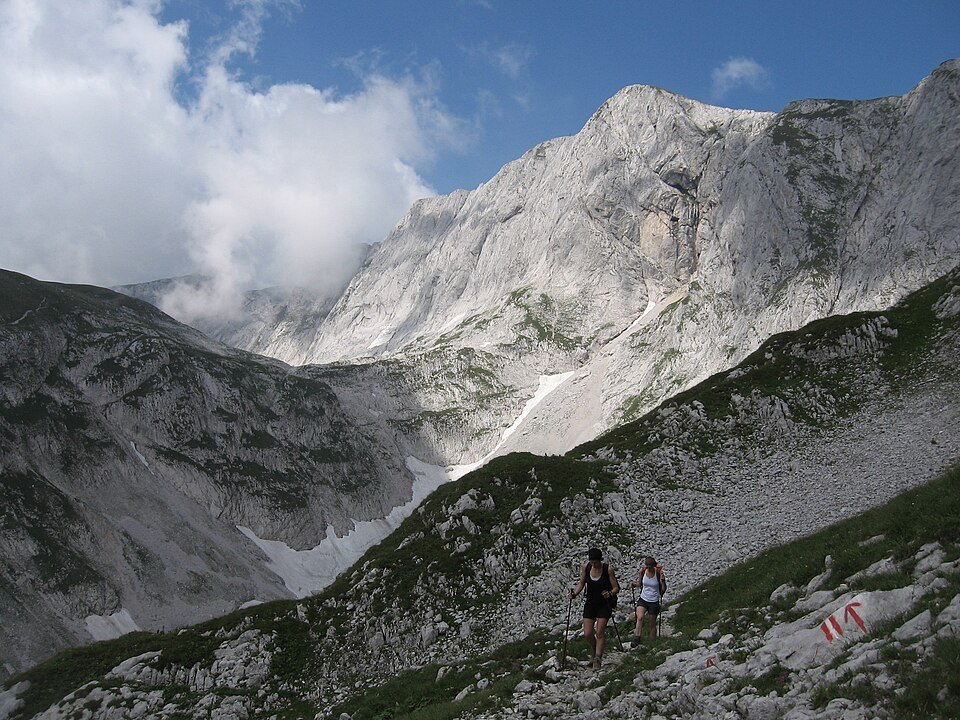
A Plateau from the Depths of Earth History
The Hochschwab group is a karstified plateau mountain whose distinctive topography derives from processes in the Miocene. The so-called Altflächen — originally level surfaces that were raised in the course of Alpine uplift — extend above 1,330 metres and display a gently undulating relief. This character fundamentally distinguishes the massif from the more rugged mountain forms further west: whoever reaches the inner plateaus moves across surfaces whose formation lies millions of years in the past.
At the margins of these ancient surfaces, however, the terrain drops away steeply. The karst has perforated and shaped the surface; water percolates rather than flowing away in streams. This interplay of wide high plateaus and sudden escarpments gives the Hochschwab its peculiar dual nature: gentle and expansive at its core, wild and forbidding on its flanks.
Tragedies in the Southwest Wall and on the Plateau
The history of the Hochschwab is also a history of dramatic accidents that abruptly illuminate the nature of the massif. On 9 May 1937, a three-person roped party — Ulrich Sild (1911–1937), Walter Mittelholzer (1894–1937) and Liselott Kastner, née Lorenz (?–1937) — fell in the southwest wall of the Stangenwand. Rockfall was given as the probable cause.
More than fifty years later, in early November 1988, a mountain tragedy occurred on the Hochschwab that triggered what was at that time the largest search operation in the history of Styrian mountain rescue. A group of seven had been trapped for two days and nights by storms and icy temperatures at around 2,000 metres altitude. Despite the deployment of 150 alpine gendarmerie officers and mountain rescuers as well as five helicopters, five of the seven persons could only be recovered dead; two survivors were rescued. The 1988 tragedy stands as a compelling testament to how quickly conditions on the apparently gentle plateau can turn life-threatening.
Nature Conservation and the Legacy of the Hochschwabperlen
The Alpine Club Austria, Voisthaler section, has made a particular commitment to nature conservation in the Hochschwab area. Under the concept of the so-called Hochschwabperlen, the section documents and maintains natural treasures of the massif — an engagement that underlines the high ecological value of this karst mountain. Which specific objects or biotopes are covered by this initiative does not emerge in detail from the available sources; the initiative itself shows, however, that the massif is perceived as a natural environment worthy of protection beyond purely mountaineering interests.