
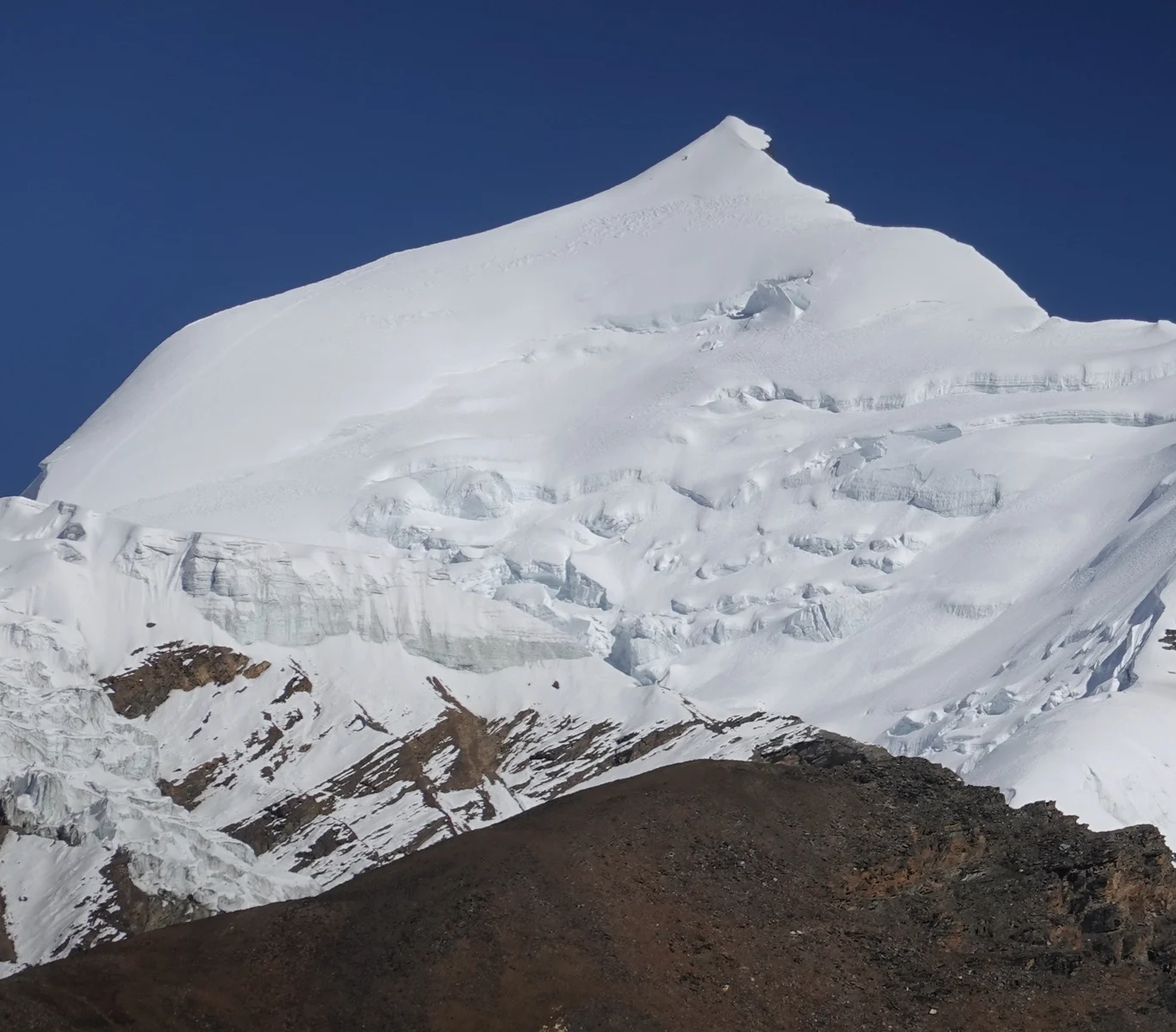
A Summit Defined by Confusion
For much of the twentieth century, the name Himlung was applied loosely to peaks in this corner of the Peri Himal, and earlier expeditions used it to refer to what maps and later analysis identified as Nemjung — a separate summit. The American Alpine Journal's subsequent record explicitly assigns a 1983 Japanese ascent to Nemjung rather than to Himlung Himal itself, clarifying that those two peaks had long been conflated by climbers working from imprecise field surveys.
The government of Nepal records Himlung Himal's coordinates as 28°46′18″ N, 84°25′29″ E, placing it in the Peri Himal within Manang district close to the Tibetan frontier. Niwa examined these government coordinates alongside mapped peak names, work that has helped clarify the overlapping identities that once made this part of the range difficult to discuss with confidence.
The 1992 Ascent and Elizabeth Hawley's Qualification
The Himalayan Database records the first ascent of Himlung Himal on 3 October 1992, credited to Osamu Hanai, Akio Koizumi, and Nima Sherpa as summit members of an expedition led by Yukio Niwa. When Elizabeth Hawley filed her immediate report for the American Alpine Journal in 1993, she described it as a probable first ascent — a careful qualification that reflected the unresolved naming history rather than any doubt about whether the climbers had reached the top.
The route carries a minor ambiguity in its description: the Himalayan Database records the line taken during the 1992 first ascent as the west ridge, while Elizabeth Hawley's contemporaneous AAJ report refers to it as the northwest ridge. Both descriptions appear in the literature.
High-Altitude Physiology on the Flanks
In 2013, Himlung Himal was the setting for the Swiss High Altitude Medical Research Expedition, a study that used sublingual microcirculation measurements taken at progressively greater elevations to examine how the human body responds to diminishing oxygen. The researchers, publishing their findings in 2019 in Physiological Reports, observed in their cohort the recruitment of capillaries that had not previously been perfused — a vascular response that could, in principle, support increased oxygen extraction at altitude.
The study was conducted on a single expedition cohort, and its authors presented the findings accordingly. It represents one carefully bounded set of observations from one high-altitude environment, notable for its methodology — measuring sublingual microcirculation directly rather than inferring it — and for its reported finding of increased capillary recruitment at altitude.
Position in the Peri Himal
Himlung Himal stands at 7,126 metres in the Peri Himal, with Nemjung lying distinctly to the south. Nepal's mountaineering registry lists Himlung East as a separate peak from Himlung Himal, a distinction that reflects the range's complex summit geography in this part of Manang.
The long shadow cast by the Nemjung confusion is a reminder of how consequential naming can be in high-altitude cartography. Peaks in this region were described by multiple national expeditions over decades, each working from local guides, prior reports, and surveys of varying precision, and the results did not always agree. Himlung Himal's established identity today rests on the alignment of government coordinates, Himalayan Database records, and the retrospective correction of the 1983 Nemjung ascent — a convergence that arrived only after the first confirmed summit had already been reached.